
The Inadvertent Time Capsule of Peggy Herbsion MP
Our blog this month is written by Mari Takayanagi. Mari is Senior Archivist at the Parliamentary Archives and currently Archives By-Fellow at Churchill Archives Centre, researching women, Parliament and politics in the 20th century. This blogpost draws on her paper ‘An inadvertent time capsule: The material culture of Peggy Herbison and other women MPs, c.1930s-1950s’, given to the Women’s History Network annual conference at Royal Holloway, University of London, in September 2024.
In 2005, a desk was pulled out of Parliamentary storage for use by staff. Inside was found a small cache of papers and other objects which had belonged to Margaret Herbison MP, apparently undisturbed since mid-1950. The items form a snapshot of her political and personal life at that time.
As an accidental survival, it might compare to the collection of interwar MP Mary Agnes Hamilton at Churchill Archives Centre. Heidi Egginton has written about how her diaries and other papers survive only because they were assembled for someone else’s biography! And it might also be compared to self-archiving by a few other early women MPs who created and kept records such as scrapbooks; Cherish Watton argues that scrapbooks are a form of life writing, potentially functioning as a diary, photo album, autobiography, and broader archive. This blog will consider the significance of the Herbison collection as a way of understanding one of the post-war women MPs.
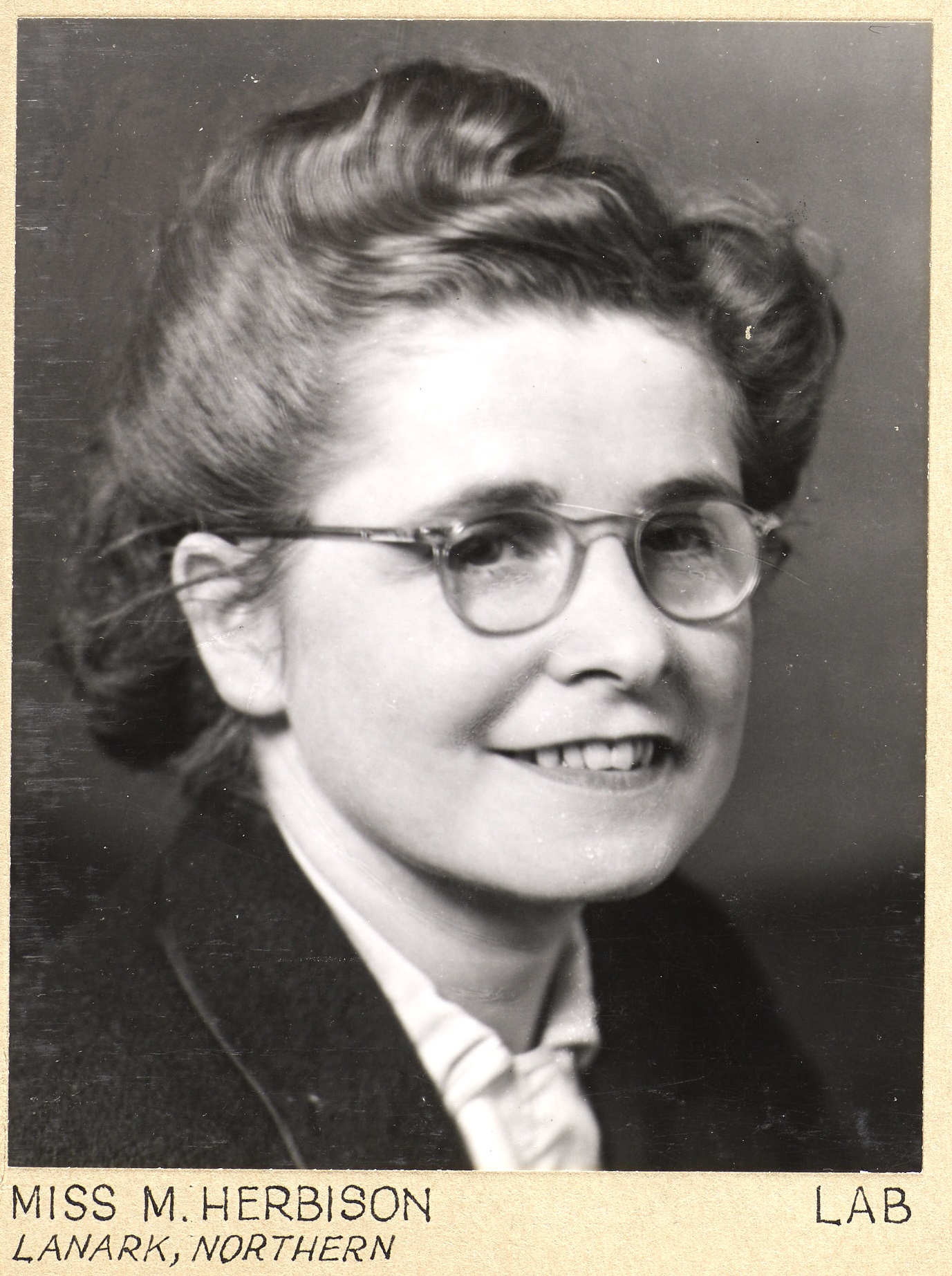
Margaret Herbison, known as Peggy, was Labour MP for North Lanarkshire 1945-1970. In 1950 she was best known for seconding the House of Commons address in reply to the king’s speech in 1947; and as the only woman member of the first British delegation to the consultative assembly of the Council of Europe in 1949. In February 1950, following Labour’s narrow general election victory, she became a junior minister, joint parliamentary under-secretary of state for Scotland.
The collection is an inadvertent time capsule of that period. It is not large, comprising two archive boxes. As well as papers, artefacts include a coin purse, a calendar with Clement Attlee’s picture and a briefcase with tartan interior – reflecting her Scottish heritage. The diary, sadly, records only a few scattered appointments; it’s also dated a few years earlier than everything else, and looks like something she put away and forgot about. We can only assume nobody knew all this was inside the desk when it was put in storage in mid-1950.

The papers reflect her interests on various topics. There is Labour party material relating to women – copies of ‘Labour Woman’ and a souvenir programme from the Scottish Labour Women’s Conference – and also more general Labour material. Herbison had been elected a member of the national executive committee of the Labour Party in 1948, and there are other Labour meetings papers.
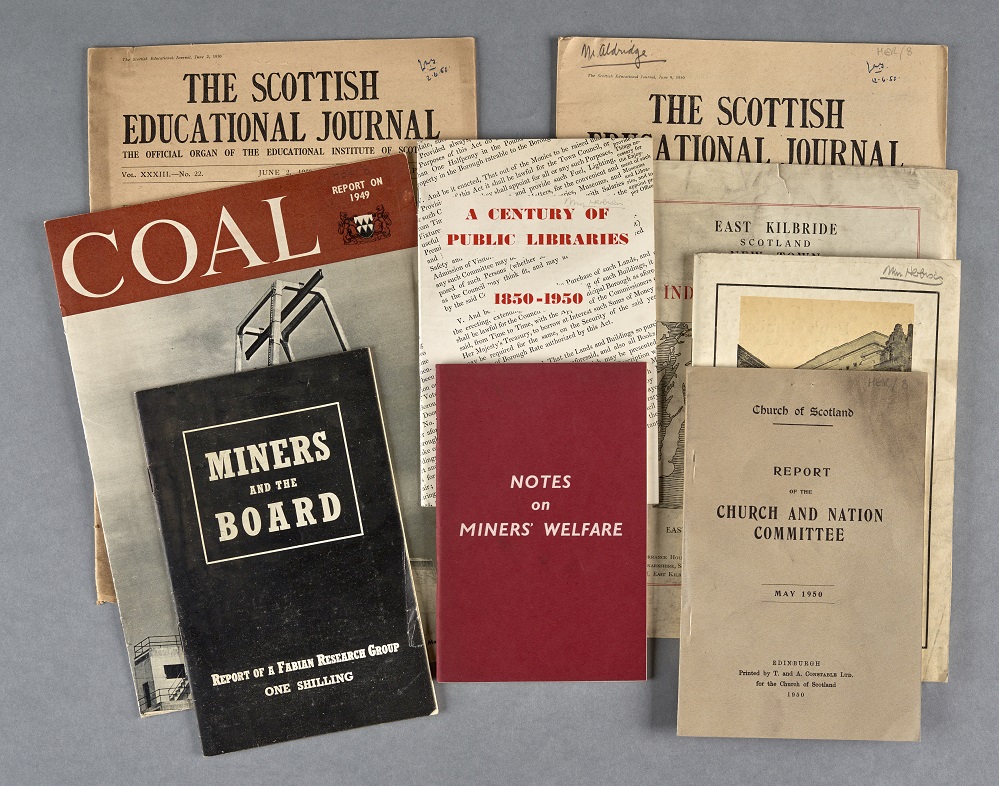
Scotland runs through everything. This image shows a tranche of material on education, libraries, the Church of Scotland (of which she was a devout member) – and especially prominent, items on coal and mining. Herbison’s father had died in a mining accident and his miners’ lodge nominated her as a Labour Parliamentary candidate on his death. There are also Parliamentary Papers, official reports on education in Scotland, the Department of Health for Scotland, and the Boundary Commission for Scotland; and other papers relating to Scotland, including on civil defence and the Scottish Physiotherapy Hospital and School.
And there are some truly personal papers – a copy of ‘Readers Digest’; a magazine from Allen Glen’s school, at which she previously taught; a route map for British European Airways. There’s also a letter from a constituent asking for tickets to see a Parliamentary debate in July 1950. There is nothing dated later than that, so this may have been when the desk was removed. Hopefully the constituent got a reply to his letter!
How much value can there be in such a random assortment of accidentally preserved material? Clearly it has limits. We don’t know if she actively read and would have kept all these papers; or if most were ephemeral, of short-term interest; or if she read them at all. Perhaps some just landed on her desk for information, as a Scottish minister. They only relate to a few early years in a long political career. She apparently didn’t seek to get them back, perhaps showing they were of no value to her.
And yet there is nothing else. A search of Discovery, the catalogue maintained by The National Archives, for record creators, shows no other collections of her papers in archives anywhere in the UK. When there is such a paucity of sources, every little helps. This small collection forms a snapshot of her Parliamentary life in mid-1950, demonstrating her interests and priorities early in her Parliamentary career. They help balance against that of later more obvious career achievements such as being Minister of Pensions and National Insurance, and then Minister for Social Security, between 1964 and 1967.
It is also absolutely honest. She was not able to remove the ‘Readers Digest’ for example, in order to convey any message or image about herself. It is there for us to interpret and explore as we wish; a collection frozen in time, evidence for a ‘day in the life’ of an MP in 1950.
As an inadvertent time capsule, the Herbison collection differs from other more curated collections such as diaries and scrapbooks. Yet its jumble of material culture has similarities with scrapbooks; selected by accident rather than by design, but nevertheless forming a snapshot evoking both personal and political interests at an early moment in her career.
Text Copyright © 2024 Mari Takayanagi
Cite this page as: Mari Tekayanagi, ‘The Inadvertent Time Capsule of Peggy Herbison MP’, Women’s History Scotland blog (04 November 2024), https://womenshistoryscotland.org/?p=3444, accessed [todays date]
To find out more about Mari Takayanagi’s research visit Parliament and Women in the early 20th century – snippets from my historical research
Follow Mari @satisfactory20 on Twitter/X and BlueSky
To contribute to our blog, please get in touch!