
Black Agnes
Our September blog has been written by Shelley Williams, a member of WHS who is currently completing her doctoral degree in medieval English language and literature at the University of Oxford. She is also working on a long-term project centered on Black Agnes of Dunbar, with the intention of publishing a book on the subject. In this blog, she explores the romantic legend of Black Agnes, questioning why she is singled out as an exemplary warrior woman of the Middle Ages, and if this depiction is accurate.
Sir Walter Scott’s former home, Abbotsford, is a life-size cabinet of curiosities crammed with beautiful, peculiar, and whimsical items which pique the imagination. It cannot be taken in all at once. Some items, however, do draw attention because of their special placement. One such item is the plaster cast of the skull of Robert the Bruce, situated at eye-level on the mantlepiece directly opposite the entrance threshold, reverently deposited and labeled.
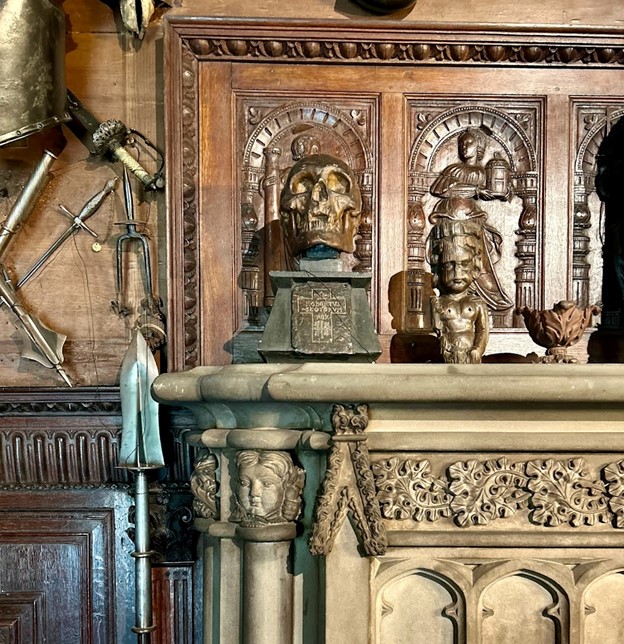
This experience is not unlike diving into medieval Scottish history in general. Robert the Bruce takes a reverent position at the dead center. This is partially due to contemporary source material, such as John Barbour’s epic poem The Brus (1375), which narrates Bruce’s kingship as the story of fourteenth-century Scotland. This set the precedent for how Scottish medieval history was written, imagined, and interpreted ever since.
But this view obscures the fuller picture. It certainly obscures how women shaped medieval Scotland. Women are, in most cases quite literally, footnotes. One who manages to escape obscurity is Agnes Randolph, Countess of Dunbar and March (1312-1369), better known as Black Agnes of Dunbar. She is one of Scotland’s national heroines, highlighted in a handful of pages in recent publications such as Mairi Kidd’s Warriors and Witches and Damn Rebel Bitches: Scottish Women to Live Your Life By (2020) and Rosemary Goring’s Scotland, Her Story: the Nation’s History by the Women who Lived it (2022), and even a bit on CBBC’s Horrible Histories.
She is famous for her exemplary defense of Dunbar castle against the English in 1338. Without trained soldiers and no military support, she withstood a brutal siege for five months. She was prepared for battle, and with limited resources managed to oversee the building of a catapult which flung boulders onto the enemy siege engines, utterly destroying them and killing many of the attackers. Her cliffside castle meant she was open to both land and sea attacks, which she withstood with aplomb. Perhaps most impressively, she managed to keep her household alive and fed. She was pithy and clever and had nourished loyalty among her kith and kin. It is indeed the stuff of romance, and a romance it became. Retellings of her tale accrued the trappings of legend, and the last prediction attributed to Thomas of Erceldoune (or Rhymer, or ‘True Thomas’) foretells the demise of Black Agnes.
Agnes clearly exhibited the characteristics of a natural leader with exemplary courage. But she did not operate alone. She relied on networks both within her household and without. Much is made of the absence of Agnes’ husband during the siege, but properly defending one’s home was part of being a noble Scotswoman. Her great-aunt Christina Bruce had defended Kildrummy castle – also without her husband – only a few years before in 1335. Even the folktales and myths of Scotland tell of women successfully protecting what belongs to them.
My research project involves a fuller exploration into the events and choices that determined Agnes’s victory over the English. Who was she? Why was preserving the castle of Dunbar so critical to Scottish survival? How much is history, and how much legend? What were the long-term results of her victory, both for her, her family and the nation? How was she remembered? How was she depicted through the centuries, and why?
We need to rethink the way we approach women in the Middle Ages. Women’s history is more than the exceptional individuals who managed to wriggle away from obscurity. It is made of complex networks of people, traditions, and ideas, building the warp and weft of history in a much bigger tapestry. Societies such as Women’s History of Scotland are crucial in creating a new vision of history for the future, specifically by promoting just such networks. Shining a light on both individuals and the fulcrum which created them has never been more important than the current moment, especially because public attention tends to focus singularly on individuals and not contributing events and influences. Black Agnes was indeed exceptional, but she was formed in a powerful network of women, and expanding beyond the romance and into history illuminates the fascinating world she lived in.
Text Copyright © 2024 Shelley Williams
Cite this page as: Shelley Williams, ‘Black Agnes’, Women’s History Scotland blog (21 September 2024), https://womenshistoryscotland.org/?p=3387, accessed [todays date]
To find out more about Shelley Williams and her publications click here
Black Agnes makes an appearance in a previous WHS blog about historical pageants from Linda Fleming. In 1948, the legend of Black Agnes inpsired a tableau performed by the Arbroath Branch of the British Housewives’ Association.
To contribute to our blog, please get in touch!