
On Holocaust Memorial Day, we are bringing you a blog about Jane Haining, a Scottish missionary and matron of a Church of Scotland girls’ home in Budapest, Hungary, who died in Auschwitz. The blog was written by Shona Paget, an undergraduate at the University of Strathclyde, and forms part of the work she completed on the Mapping Memorials project during her placement as a work placement student.
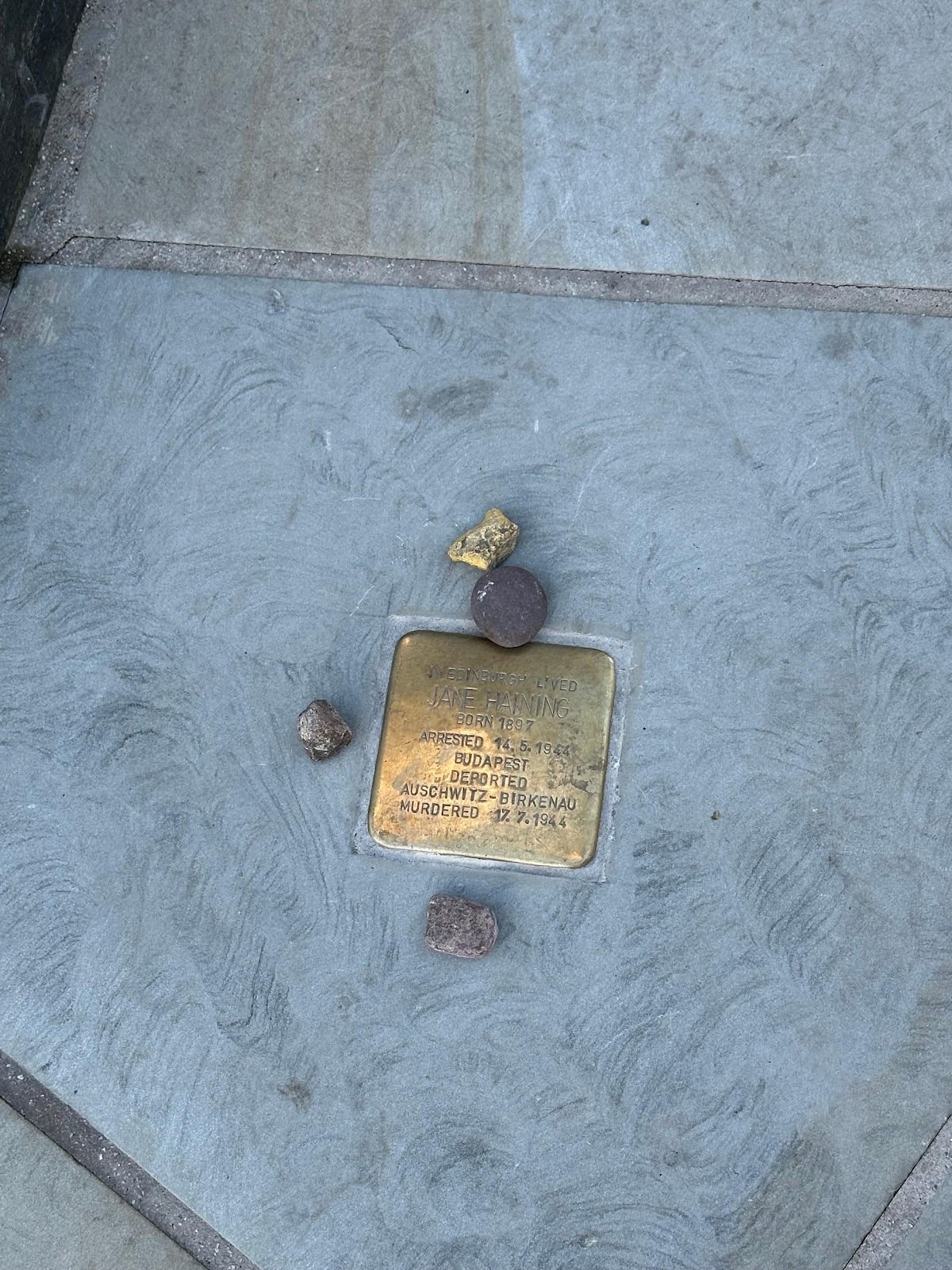
80 years on, the courageous acts of Jane Haining are still being remembered. On 24th November 2025 St Stephen’s Church in Stockbridge, Edinburgh unveiled a plaque remembering her as a victim and most predominantly a heroine of the Holocaust.

In 1932, Haining left her village (Dunscore) in Dumfriesshire to work as a Matron at the Scottish Mission School in Budapest. According to Dr David Kaufner (Director of Modern Conflict at the University of Edinburgh), Budapest had a large population of middle class Jewish citizens, with 60% of the doctors and lawyers in the city being Jewish. The city was dubbed “Judapest”. The boarding school was primarily a Christian School but took on many Jewish pupils. The school earned a reputation for providing a good education, which is why many parents wanted their child to go there. The school cared for 400 pupils, a mix of day and boarding; some of the pupils were orphans or their parents had abandoned them at the institution, and in the care of Haining.
By 1939, the Nazis had invaded a large part of Europe and fascism was on the rise. The Nationalist Hungarian government had so far managed to protect its Jewish citizens but pressure was building from the extreme and demanding Hungarian fascists. Although with pressure mounting the Hungarian government began to detain Jews who’d been living in Budapest without citizenship and it wasn’t long before the greater Jewish population began to lose their jobs, civil rights, social status and respect from fellow citizens as fascism/fear spread.
In March 1944, the Nazis stormed their way into Budapest. The Church of Scotland were in fear of the safety of their missionaries and sent letters requesting Haining to return to Scotland. She refused, she had the choice to leave but stayed for the protection and care of the children. New rules for the Jewish community were enforced by the Nazis; notably for the Star of David to be worn by all Jews. It is said that Haining wept as she sewed on the Stars to clothes of her Jewish pupils.
Haining and fellow teachers were distraught and outspoken about the treatment of Jews but it wasn’t until an unfortunate incident that led to her arrest. In April 1944, the school’s cook’s son in law spotted Haining eating some of the food meant for the Jewish children at the school (food was severely scarce at the time). He informed the Gestapo, who arrested her in front of her pupils. Agnes Rostas (a former pupil) recalls the incident and Haining’s tearful statement as she was led away: “Don’t worry, I’ll be back by lunch.”
The ground of her arrest was on suspicion of “espionage on behalf of England.” Haining was imprisoned in Budapest and charged for eight offences. One of the charges was working amongst the Jewish. Whilst at the police station she was interrogated and profusely denied talking about politics. Despite her defence, she was carted off to Auschwitz- Birkenau on the 14th May 1944 as a political prisoner, in a cattle cart along with other prisoners of war. During this period, around 12,000 Hungarian Jews faced the same devastating journey, thousands met their fate at the gas chambers.
Upon arrival she was branded with her prisoner number 79467, via the camp’s tattooist and put in one the many barracks that were home to up to 300 women in each hut. It had been discovered that political prisoners faced regular beatings, verbal abuse and being chased by the guard dogs. It is likely Haining succumbed to manual labour in the mines and measly portions of soup to see her through 14 hour shifts. With the harsh conditions and lack of food, she became poorly after 2 months in the camp. The German documented that she was taken to the hospital for treatment/care as they had diagnosed her with cachexia (a complex condition that is linked to malnourishment and comes with underlying health issues) after having inflammation of the intestines. Although historians debate the hospitalisation and some predict she was one of the millions who had their lives end in the gas chambers. Haining died at the age of 47, after refusing to stand down to the fascists and for her care/compassion to vulnerable children.
It was not until 1997 that a 10 year investigation was launched by an Israeli Board (initiated by Queen’s Park Church, Glasgow) to find information of those of the Holocaust. Haining is the only Scottish person to be named in The Righteous Among Nations (non Jewish people who risked their own lives to save Jewish people/communities). In 2010 the British Government awarded her a Hero of the Holocaust medal. The St Columba Church of Scotland in Edinburgh honored her life with a plaque at their entrance.

The newest memorial to her has been placed in a Stolperstein Stone (a brass plate embedded into the pavement near the home or association of the Holocaust victims) at St Stephen’s Church in Stockbridge. The location was chosen because in 1932 the church held a service for Haining before she left to Budapest to become a matron.
It is important that she and other victims/heroes of the Holocaust are remembered for their bravery, courage and care during the attempted genocide conducted by fascist groups. It is important history does not repeat its mistakes, instead it is better to learn from history.
References
Plaque for Scottish Holocaust victim unveiled in Edinburgh
Budapest honours Scots Holocaust heroine who died in Auschwitz
Jane Haining: The Scot who died in Auschwitz
Text Copyright © 2026 Shona Paget
Cite this page as: Shona Paget, ‘Jane Haining’, Women’s History Scotland blog (27 January 2026), https://womenshistoryscotland.org/?p=3933, accessed [todays date]
To contribute to our blog, please get in touch!