
Under the theme ‘Women’s History in Scotland: Then and Now’, the Winter Showcases will bring together researchers from across the community for a series of themed online sessions exploring women’s and gender history in Scotland. Each showcase will feature three to four complementary 15-minute papers, followed by discussion and Q&A, creating space to explore new research, challenge established narratives and consider the changing approaches to women’s and gender history. The showcases will be hosted on Zoom.
Winter Showcase Programme 2026/27
Theme: Discovery and Dissemination: Women in Historical Practice and Heritage
Speakers: Rosalind Anderson, Hannah Speed and Yang Yang
Date: 16 December 2026
Time: 7pm to 8.15pm
Sign up via Ticket Tailor
Rosalind Anderson
The Buried Stories of Women at Dunblane Cathedral’s Graveyard and the Presentation of These to the Public
The medieval Cathedral at Dunblane has attracted considerable attention over the years, but its graveyard has been comparatively overlooked. During the COVID-19 pandemic, work on lair and burial records undertaken by Historic Environment Scotland to support headstone inspections uncovered a number of fascinating stories.
The available sources are dominated by ministers, lawyers, military figures and church elders, making it relatively easy to trace detailed lives of the men buried there. The women, however, have often proved harder to uncover.
Previously, stories about women in Dunblane were largely based on local tales, with limited documentary evidence, which were subsequently repeated and embellished. By developing a deeper understanding of family connections within the town and identifying new sources, Rosalind Anderson has been able to challenge these narratives and uncover significant, previously unknown stories about women buried in the graveyard.
These include sisters blamed for their brother’s dramatic love life; a Methodist whose 3x great-grandmother knew John Wesley; and women who ran businesses that helped keep the town functioning, including the woman who served as innkeeper at the Stirling Arms Hotel for 44 years.
Presenting these stories to the public has brought its own challenges because of site-specific restrictions. These have recently been addressed through self-led audio tours offered by the Society of Friends of Dunblane Cathedral via the Echoes app.
Two tours were developed for simultaneous launch. When it proved difficult to find women to record the narrations, colleagues at Historic Environment Scotland, many of whom have a working connection to the site, volunteered to take part. This included a female stonemason who narrated a story with a connection to the stonemasonry trade.
The approach has attracted interest from local people, tourists and other graveyard groups through the Legacies in Stone project.
About Rosalind Anderson
Rosalind Anderson is a member of the Society of Friends of Dunblane Cathedral and has written several articles for its journal, as well as contributing to a book on the cathedral’s stained glass. She has also written a booklet on the history of the graveyard and leads plans to excavate buried flat stones there.
Rosalind is employed by Historic Environment Scotland as a steward at Dunblane Cathedral and has worked at several historic sites, including Huntingtower Castle. Her work at Huntingtower Castle formed the basis of her book The Jacobite Rising of 1715 and the Murray Family, published by Pen & Sword.
Hannah Speed
Towards a Gender Audit of the Modern Political Archival Collections at the National Library of Scotland
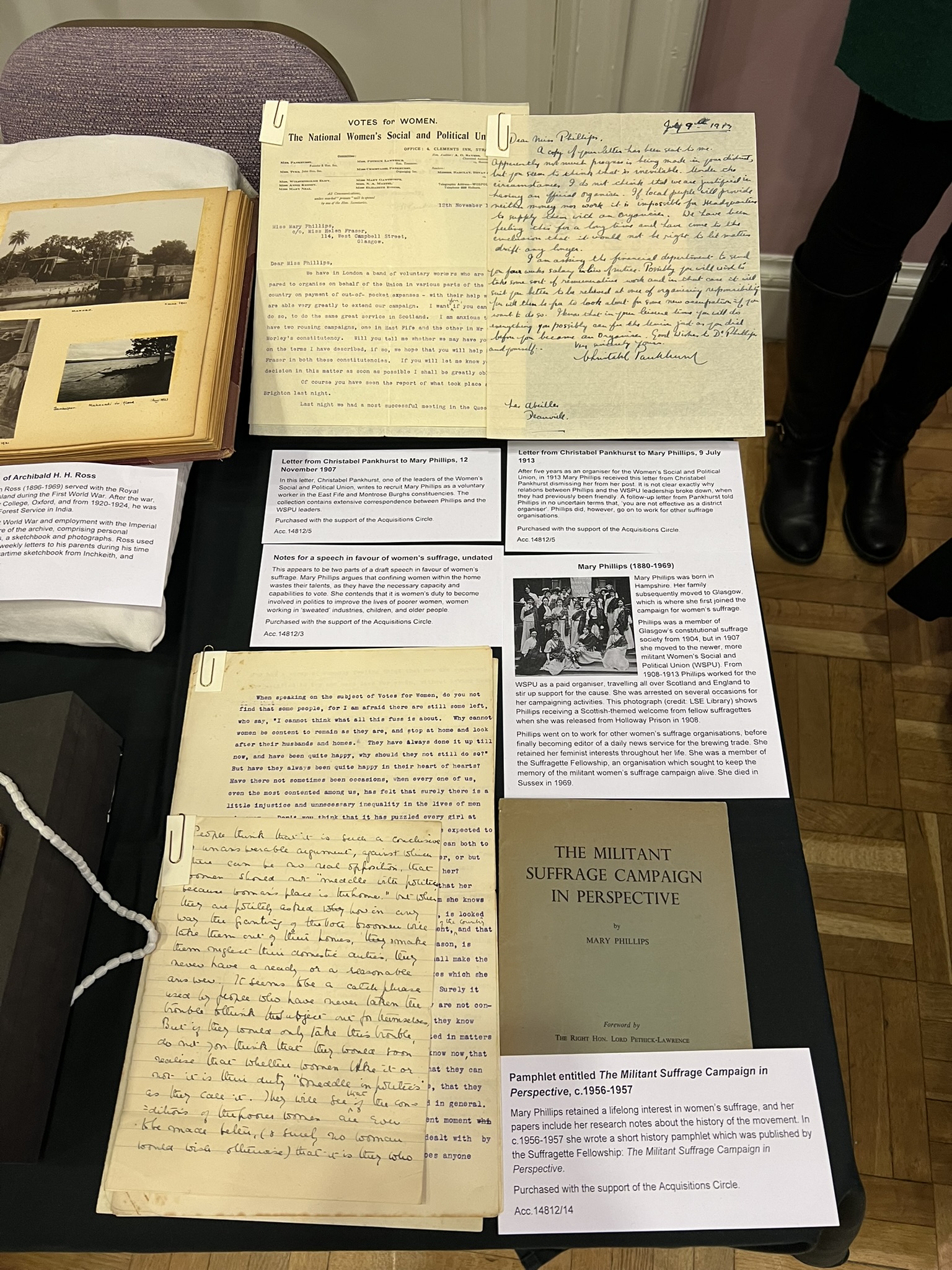
This paper presents the findings of a 2026 research project in the Archives and Manuscripts Division of the National Library of Scotland, entitled “Towards a Gender Audit of the Modern Political Collections at the National Library of Scotland.”
The project asks how we might begin to assess gender representation within the National Library of Scotland’s vast holdings, and what might be done to address gaps in representation.
The research sits within a wider movement in the archives sector to improve the diversity of collections and the inclusiveness of catalogue descriptions and engagement programmes. It was informed by, and developed in dialogue with, these approaches and with feminist archival theory.
The paper explores the particular circumstances of the National Library of Scotland as a national institution, with a specific focus on Scottish collections. It draws on practical case studies from the NLS and other Scottish archives developed and collected during a six-month SGSAH-funded internship project.
Particular attention is given to the challenges of fully representing women’s political contributions in archival collections, including the different roles women have played both as political actors and as collectors and donors of the political archives of others.
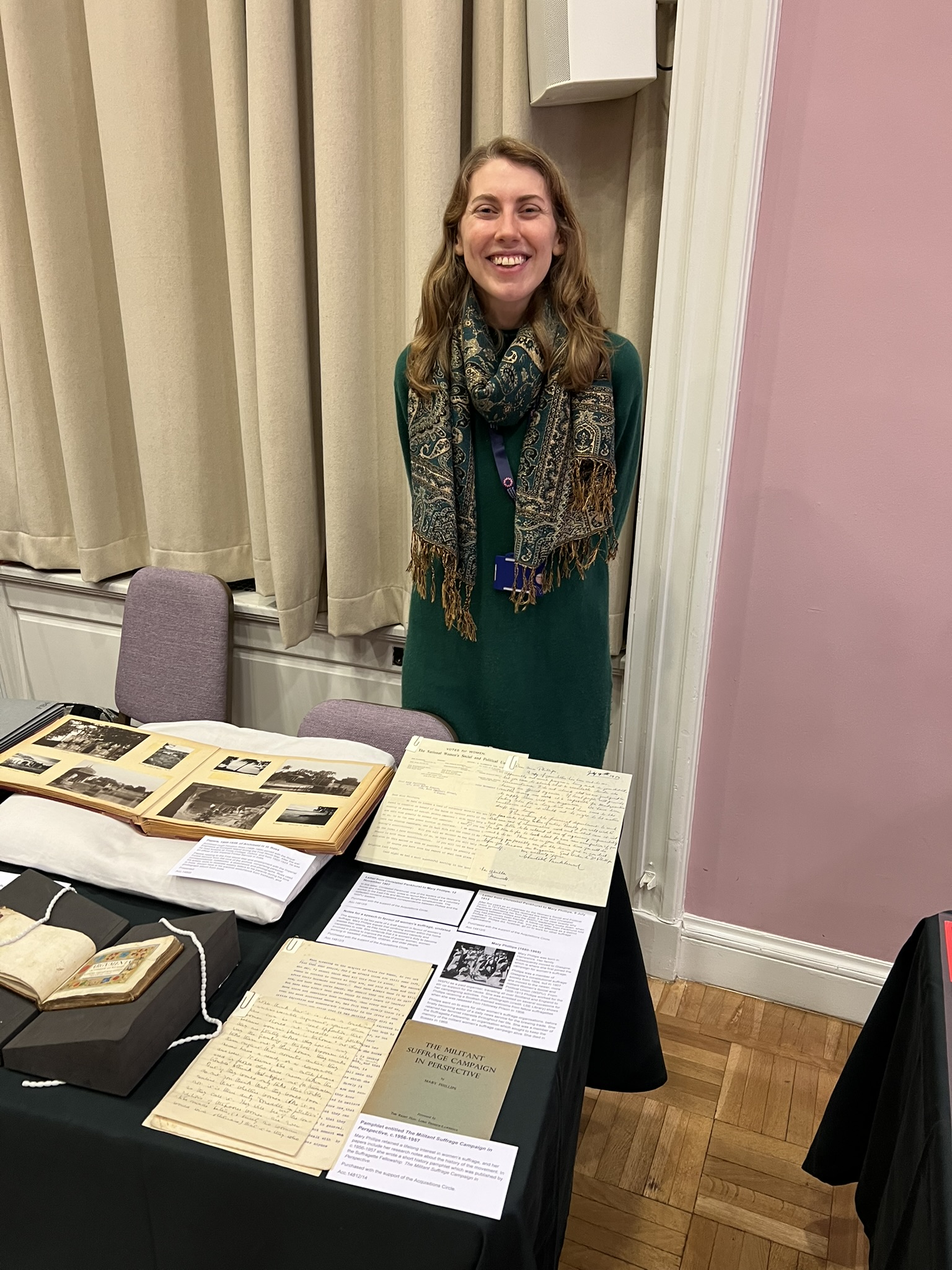
The paper considers the history of women’s political collections at the NLS, current concerns, and suggested good practice for improving gender representation. These recommendations span the full lifecycle of an archive, from collecting and cataloguing through to digitisation and public engagement, encompassing both policy and practice.
Through this analysis, the paper also sheds light on the conditions under which women’s and gender history has been researched in Scotland over the past century. It demonstrates how archives can both respond to, and in turn shape, developments within the discipline of history.
About Hannah Speed
Hannah Speed is a part-time PhD student in History at the University of Glasgow. Her PhD, Women’s Life-Writing and the Suffrage Campaign in Scotland c.1890s–1990s, brings together her research interests in personal testimony as a genre, women’s activism in nineteenth- and twentieth-century Britain, and gender as a lens for historical analysis.
Hannah is also a member of the Women’s History Scotland Steering Committee.
Yang Yang
A Case of ‘the Other’ Women: Depicting Chinese Women in Writing History of Women in the Scottish Enlightenment
This paper examines the textual representation of Chinese women in the works of Scottish Enlightenment thinkers, focusing particularly on John Millar’s The Origin of the Distinction of Ranks, Lord Kames’ Sketches of the History of Man, and William Alexander’s History of Women.
It asks how the Scottish Enlightenment thinkers presented Chinese women in their works and how these representations intersected with evolving ideas of civilization, gender, and China.
It shows that by engaging with sinological texts and Jesuit records (such as Jean-Baptiste Du Halde’s accounts) as the primary sources, the Scottish thinkers presented Chinese women, on the one hand, as models of elegance, chastity, and modesty in dress and behavior, and, on the other hand, as lacking personal independence and property rights. This paper argues that this representation of Chinese women resonated deeply with Scottish ideals of female virtue and mirrored the theoretical tensions they faced in interpreting Chinese men and placing Chinese civilization within the stadial theory of progress.
About Yang Yang
Yang Yang is a recent graduate of Central European University (CEU). Their research focuses on how knowledge about women, particularly Chinese women, was transformed within Enlightenment contexts and incorporated into local intellectual frameworks.