
This month Megan Gamble (she/her) shares her research about the role of women in the Scottish Covenanter Movement by analysing A Cloud of Witnesses (1714), a martyrology of Scottish Covenanters executed for defying royal and Anglican authority. This blog highlights how female martyrs like Isabel Alison and Marion Harvie used public, affective resistance to challenge gender norms and state power. Megan Gamble is a Master of Arts student at the University of Guelph, Canada, where she studies the Covenanters through an emotional and gendered lens under the guidance of Dr. Cathryn Spence.
A Note to the Reader: To engage with the primary source material discussed, direct your attention to pages 77–94: A Cloud of Witnesses (1714).
A Cloud of Witnesses (1714) is a text that resists easy categorization—it is part legal document, part spiritual autobiography, and part ideological treatise. The martyrology includes the final speeches, testimonies, and legal indictments of Scottish Covenanters executed between 1680 and 1688 for rejecting Anglican reform and Stuart royal supremacy. Compiled by the United Societies—a radical militant Covenanter group influenced by Richard Cameron’s teachings—the text functions simultaneously as a commemorative archive and a theological polemic. Far from being a neutral historical record, it is a deliberate theological intervention, affirming Presbyterian covenantal legitimacy while denouncing the authority of royalists and Episcopalianism. As such, it demands an interdisciplinary reading attentive to its emotional, rhetorical, and historical dimensions. Notably, despite the movement’s professed egalitarianism, sixty of the sixty-four recorded accounts pertain to men, with only four (2.5%) devoted to women. Yet, the testimonies of figures such as Isabel Alison and Marion Harvie provide nuanced insight into how gender, power, and emotion intersect within this framework of religious resistance.
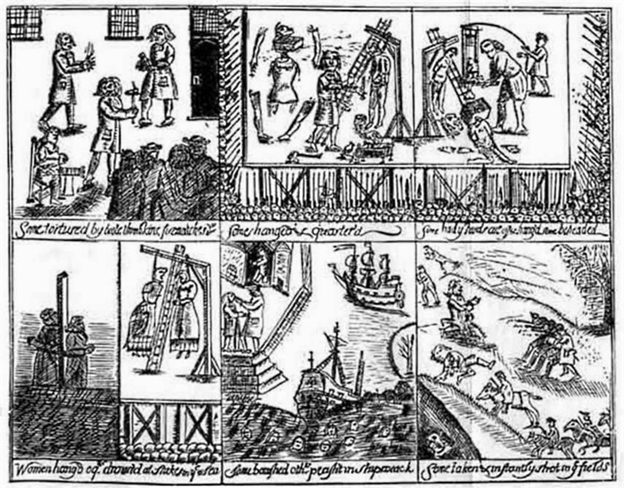
The Covenanting movement began in the 1630s, when Scots resisted King Charles I’s imposition of Anglican liturgy as presented through the 1637 Book of Common Prayer. In response, Protestant—and some Scottish Episcopalian—nobles, clergy, and laity signed the National Covenant of 1638, asserting Scotland’s ecclesiastical and political independence. In response, Protestant—and some Scottish Episcopalian—nobles, clergy, and laity signed the National Covenant of 1638, essentially asserting Scotland’s ecclesiastical and political independence. This declaration functioned as a catalyst for the Covenanter’s struggle for religious and political freedom, resulting in events such as the Bishops’ Wars (1639–40), which marked the beginning of broader wars in the three kingdoms. The Covenanters, asserting Presbyterianism as the rightful form of church governance, initially allied with the English Parliament during the English Civil War, culminating in the Solemn League and Covenant of 1643; however, inevitably, tensions emerged over the role of monarchy and church structure. Indeed, because of such tensions and demands, following the execution of Charles I in 1649, Scotland proclaimed Charles II as king, conditional on his acceptance of the Covenant. Two years later, he was crowned at Scone Palace, Perthshire, in 1651 but was soon defeated by Cromwell’s forces, leading to the incorporation of Scotland into the English Commonwealth in 1652, whereby Scotland experienced a period of military occupation and republican rule under Cromwell. Upon Charles II’s restoration in 1660, he renounced Presbyterianism, enforcing conformity through the Rescissory Act (1661) and the Abjuration Act (1662), which banned conventicles and expelled nonconforming ministers. Uprisings in 1666 and 1679, followed by the 1680 Sanquhar Declaration, led to intensified repression, and thus, mass executions were authorized for dissenters. These executions recorded in A Cloud of Witnesses, therefore, occurred during “The Killing Times,” a period of intense persecution under Charles II and James VII. This persecution ended with the Glorious Revolution of 1688–89, culminating in the 1690 Act of Settlement and the formal re-establishment of Presbyterianism.
Historiography’s longstanding neglect of emotion—rooted in the discipline’s privileging of empirical objectivity—has obscured the ways in which gender and affect are understood to have operated within structures of resistance. William Reddy’s theory of emotional regimes, drawing on J. L. Austin’s speech-act theory, may offer a much-needed corrective. William Reddy’s theory of emotional regimes, drawing on J. L. Austin’s speech-act theory, offers a corrective. Emotives, according to Reddy, are performative utterances that express and simultaneously shape inner states. Thus, emotional regimes dictate which emotions may be expressed, by whom, and in what context, rendering emotion a mechanism of political and gendered control. As a deeply affective and emotional text, A Cloud of Witnesses is ripe for emotional analysis, inspiring a reevaluation of how emotion in early modern Scotland shaped religious and gendered subjectivity. Using Reddy’s framework allows for an interrogation of how gender was not only imposed but potentially unmade through affective, spiritual, and emotional performances.
Isabel Alison and Marion Harvie’s testimonies subverted the emotional regimes of early modern Scotland, which idealized religious femininity as passive, penitent, and emotionally restrained. Instead, Harvie and Alison displayed masculine-coded traits, such as public rebuke, righteous anger, and unwavering resolve, which Carol and Peter Stearns’ term “emotionology” helps frame as an affective disruption. The women refused state-imposed scripts of madness—Harvie was asked, “Were ye ever mad?” and Alison if she was “distempered.” Their rejections, for example, “I have all the wit that ever God gave me,” resist efforts to pathologize female dissent. Unlike male martyrs, only women were subjected to such interrogations, reflecting an affective double standard rooted in binary gender categorizations.
Despite these gendered strategies by the Privy Council, their legal indictments mirrored those of male rebels. Since the state could neither reabsorb Alison nor Harvie into compliant womanhood nor dismiss them as irrational, they had to be eliminated. Their executions at Edinburgh’s Grassmarket, a site of public spectacle, sought to reinforce patriarchal and monarchical power by staging the erasure of transgressive political, gendered, and emotional displays. Interestingly, Harvie and Alison’s expressions of joy, certainty, and religious ecstasy exemplify what Nick Crossley calls affective plasticity—the body’s capacity to reconfigure emotion through ritual. Hence, theological martyrdom is not merely spiritual—it is also embodied and emotionally enacted. Thus, Harvie’s assertion that death was not terrible, and Alison’s claim that prison was her “palace,” invert state-imposed terror into the spiritual triumph of martyrdom (much like Perpetua, a young, well-educated woman was martyred in Carthage in ca. 200 CE for refusing to renounce her Christian faith). In doing so, these women reframed the emotional script of execution by transforming their suffering into a gendered form of testimony—one that sanctified not only their faith but also their capacity to endure pain, shame, and public death through spiritual conviction and emotional control.
Alison and Harvie’s emotive performances—conscious, rehearsed, and embodied—clearly served as a form of resistance. By condemning the Privy Council and praising Christ as their true sovereign, they enacted affective ungendering: a dual process of inhabiting male-coded emotional authority while being discursively expelled from femininity. Their final farewells—Harvie to the “sun, moon, and stars,” Alison to the “sweet Bible”—were not passive resignations but declarative acts of conviction. Thus, Alison and Harvie’s testimonies compel a critical reorientation of prevailing historiographies of early modern Scotland by foregrounding emotional analyses. By grounding analysis in an emotional framework shaped by queer praxis and poststructuralist theory, this approach enhances traditional narratives of the Covenanting movement that have either sidelined women’s roles or dismissed their affective expressions as politically insignificant. Indeed, their affective resistance unmade the boundaries of early modern femininity and redefined the emotional landscape of Covenanting identity, and these conclusions have only come to fruition through an emotional lens. As I hope I proved here using Harvie and Alison as an example, these women’s affective resistance unmade the boundaries of early modern femininity and redefined the emotional landscape of Covenanting identity. Conclusions which have only come to fruition through an emotional lens. It is my hope that by centring affective and emotional experiences, we can better understand emotion not as peripheral but as central to the production of historical agency and political resistance.
References
A Cloud of Witnesses, for the Royal Prerogatives of Jesus Christ, or, The Last Speeches and Testimonies of Those Who Have Suffered for the Truth, in Scotland, since the Year 1680. 1714. urn:oclc:record:1042119085.
Crossley, Nick. “Researching Embodiment by Way of ‘Body Techniques.’” The Sociological Review 55. no. s1 (2007): 80–94. https://doi.org/10.1111/j.1467-954X.2007.00694.x.
Doak, Laura. “Militant Women and ‘National’ Community: The Execution of Isabel Alison and Marion Harvie, 1681.” Journal of the Northern Renaissance (2020). https://jnr2.hcommons.org/2020/6081/
Reddy, William. “Against Constructionism: The Historical Ethnography of Emotions.” Current Anthropology 38, no. 3 (1997): 327–51. https://doi.org/10.1086/204622.
Stearns, Carol, and Peter Stearns. “Emotionology: Clarifying the History of Emotions and Emotional Standards.” The American Historical Review 90, no. 4 (1985): 813–36. https://doi.org/10.2307/1858841.
Yeoman, Louise. “Heart-work: Emotion, Empowerment and Authority in Covenanting Times.” PhD diss., St. Andrews University, 1991. https://hdl.handle.net/10023/637.
Text Copyright © 2025 Megan Gamble
Contact: mgambl02@uoguelph.ca
LinkedIn: https://www.linkedin.com/in/megangamble1/
Cite this page as: Megan Gamble, ‘The Role of Women in the Scottish Covenanter Movement’, Women’s History Scotland blog (13 July 2025), https://womenshistoryscotland.org/?p=3758, accessed [todays date]
To contribute to our blog, please get in touch!