
This month, Dr Valerie Schutte shares a review of Susan Fraser King’s Queen Hereafter, a historical novel based on the lives of Saint Margaret of Scotland and her husband, King Malcolm III. Valerie Schutte is a historian of Tudor England, with a particular focus on royal women and book history. She is currently editing volumes on Queen Mary I and humanism, Tudor myths, and adaptations of the Tudors, and will publish a cultural biography of Anne of Cleves in 2026. For more details about Valerie’s research, and her upcoming projects and talks, please visit www.TudorQueenship.com.
For all of Queen Margaret of Scotland’s legacy and importance, she is subject of very few pieces of historical fiction. Instead, she is overshadowed by the later Tudor Queen Margaret, wife of King James IV. One piece of historical fiction that features Saint Margaret is Susan Fraser King’s 2010 novel Queen Hereafter. It is based on the lives of Margaret and her husband, Malcolm Canmore, King of Scots. The novel covers Margaret’s life from the time she is shipwrecked and lands in Scotland until the birth of her third son. From the very first chapter, the book sets up many dichotomies: Scotland versus England, new ways versus old traditions, religion versus witchcraft, and the Catholic Church of Rome versus the Celtic church. Yet, the real focus of the novel is Margaret’s early years as queen, especially highlighting her piety and wit.
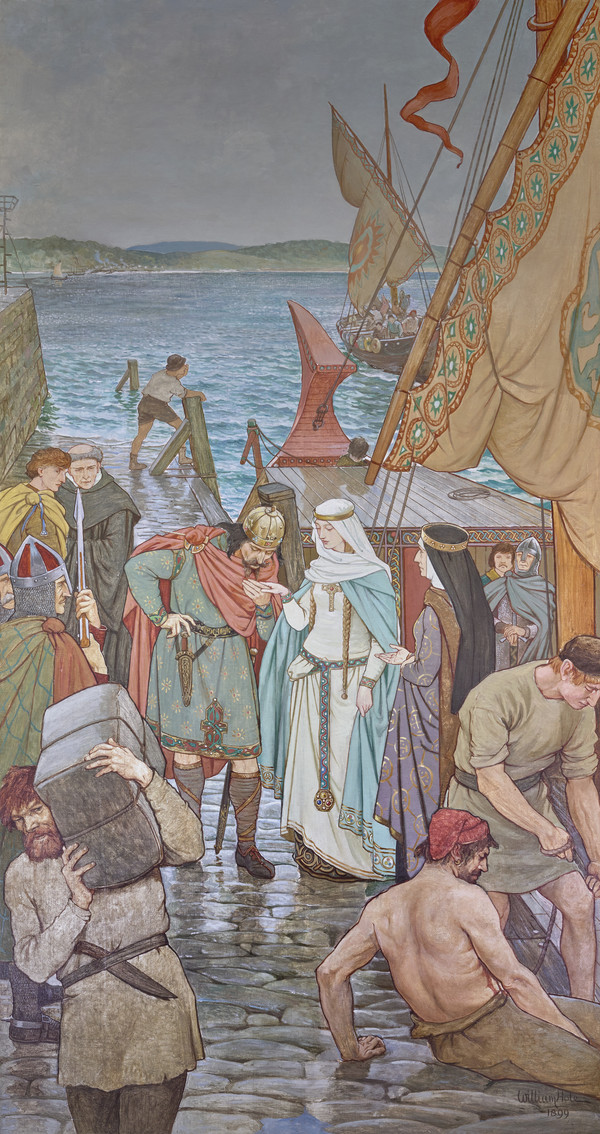
The paratextual material of King’s novel makes clear that one of her primary concerns when writing her novel was historical accuracy. King consistently tells her readers that she not only strives for historical accuracy, but also to represent the education of her characters correctly, so as to do both them and herself justice as their storyteller. In the Author’s Note, King lists the extant medieval sources of Margaret, such as annals, chronicles, and the vita written by her confessor, Bishop Turgot., King’s novel is based largely on Turgot’s vita, filling in and expanding this account of Margaret’s life with realistic scenes and dialogue. For example, in both the vita and the novel, Margaret feeds nine orphans every morning from her own spoon, regularly gives the clothing off her back to paupers, and fasts so heartily that she becomes weak and frail.
Margaret’s Gospel Book
King’s reliance on Turgot’s account comes through most clearly in her frequent invocation of Margaret’s Gospel book. The book is mentioned as early as the first chapter, in which it is represented as Margaret’s most prized possession, as well as signifies her affection for Scripture. For Margaret, her ‘little Gospel book was her most treasured and favorite volume, a collection of evangelical excerpts presented to her by England’s Queen Edith on the day Margaret had turned twelve’ (King, Queen Hereafter, 79).
Margaret’s Gospel book, and Latin education that enabled her to read it, are frequently invoked in the novel and are used to remind readers of her wit and piety appropriate for a queen and future saint. Significantly, King uses it to recreate one of the miracles that was used to promote Margaret to sainthood. Margaret seems to misplace her Gospel book one afternoon after reading it to Malcolm, who is not able to read it for himself. Weeks later, as Margaret nears giving birth to her third child, Malcolm surprises her by having her Gospel book covered with a silver binding. This silver binding protects and saves Margaret’s book when it later falls in water. The survival of Margaret’s Gospel book, both historically and in the novel, is the stuff of both sainthood and legend.
In Turgot’s vita, he describes the Gospel book being found open at the bottom of a river, yet ‘without a doubt, it was drawn up from the middle of the river intact, uncorrupt, and undamaged so much so that it scarcely seemed to have been touched by the water!’ (Huneycutt, Matilda of Scotland, 175). In King’s fictional account, ‘the scraped and polished skins had survived the soaking, the pages only a little damp’ (King, Queen Hereafter, 304). Both Turgot and King consider the survival of the Gospel book to be miraculous.
Final Thoughts
King’s adherence to Turgot’s vita also explains why the fictional Margaret’s piety, devotion, and charitable acts are written about so sympathetically. King took her cues from Turgot, who obviously considered Margaret’s actions to be of pure intent. This differs markedly from how many other pious women are represented in fiction. For example, in Philippa Gregory’s novels (and later television adaptations), Lady Margaret Beaufort is presented as a religious fanatic capable of killing the Princes in the Tower because she thought it was God’s will. In her engaging novel, Susan Fraser King humanizes Saint Margaret for a modern audience, showing how one woman could be torn between loyalties to her faith, her family, and her duties as queen.
References
Susan Fraser King, Queen Hereafter (Crown, 2010)
Lois L. Huneycutt, Matilda of Scotland: A Study in Medieval Queenship (Woodbridge: The Boydell Press, 2003)
Text Copyright © 2025 Valerie Schutte
Cite this page as: Valerie Schutte, ‘A Review of Susan Fraser King’s Queen Hereafter’, Women’s History Scotland blog (09 June 2025), https://womenshistoryscotland.org/?p=3750, accessed [todays date]
To contribute to our blog, please get in touch!