
Female Textile Designers in Britain, c. 1840-1880.
Here is a blogpost by one of our 2022 Bursary awardees Dr Sheilagh Quaile
A Research Bursary from Women’s History Scotland supported my travel to the North American Conference on British Studies (NACBS) in Chicago in November 2022, where I presented my paper “Female Textile Designers in Britain, c. 1840-1880.” For this research, I used census returns, commercial directories, newspapers, and records of the Paisley and Glasgow Government Schools of Design to identify women and girls who worked in textile design, and to better understand the educational and professional opportunities that were available to them.
As support grew for employment for middle-class women in the mid-nineteenth century, design work was promoted as appropriately feminine, since it was not physically laborious, nor need it require too much commercial involvement.[1] Gender and class stereotypes including gentlewomen’s natural “delicacy and elegance” were invoked; qualities that, it was claimed, aligned with the demands of design work.[2] The state-subsidised Government Schools of Design, which were established in cities and towns across the United Kingdom beginning in the late 1830s, perpetuated these stereotypes through classes and awards that were not only gender-segregated, but were assigned according to beliefs about what artistic subject matter was appropriate for male and female pupils respectively. For example, in 1849 the Glasgow Government School of Design (which later became the Glasgow School of Art) awarded prizes for studies from casts of classical ornament to male pupils only; prizes awarded to female pupils were exclusively for floral and botanical studies.[3] Incidentally, flowers and other botanical specimens more often featured in textile patterns. However, female pupils of the Government Schools were usually middle class, and while they excelled in their studies,[4] most of them pursued gentlewomen’s professions (e.g., that of governess or teacher) rather than skilled trades such as textile design.[5]

IMAGE: Duncan Brown, “Ingram Street, looking East,” ca. 1858. Photograph, 95 x 78 mm. The Glasgow School of Art, DB/163. Copyright The Glasgow School of Art
From 1845 until 1869, the Glasgow Government School of Design (later the Glasgow School of Art) was located on Ingram Street, Glasgow. The original building, now demolished, is one of those on the left side of the street in this image.
Census returns suggest that most women and girls who worked in figured textile design were working class and entered this occupation through family or self-instruction rather than institutional education. An example is Helen Allan (b. 1830) of Paisley, who is listed as a shawl pattern drawer in the 1851 Scotland Census.[6] Allan had an uncle who worked as a shawl handloom weaver and an elder brother who worked as a pattern drawer,[7] either of whom may have instructed her in pattern drawing. Allan may have worked from home, though some female pattern drawers may have done this work in factories. For example, Agnes Barr of Paisley is listed as a shawl pattern drawer in 1861 and a shawl warehouse worker in 1871.[8]
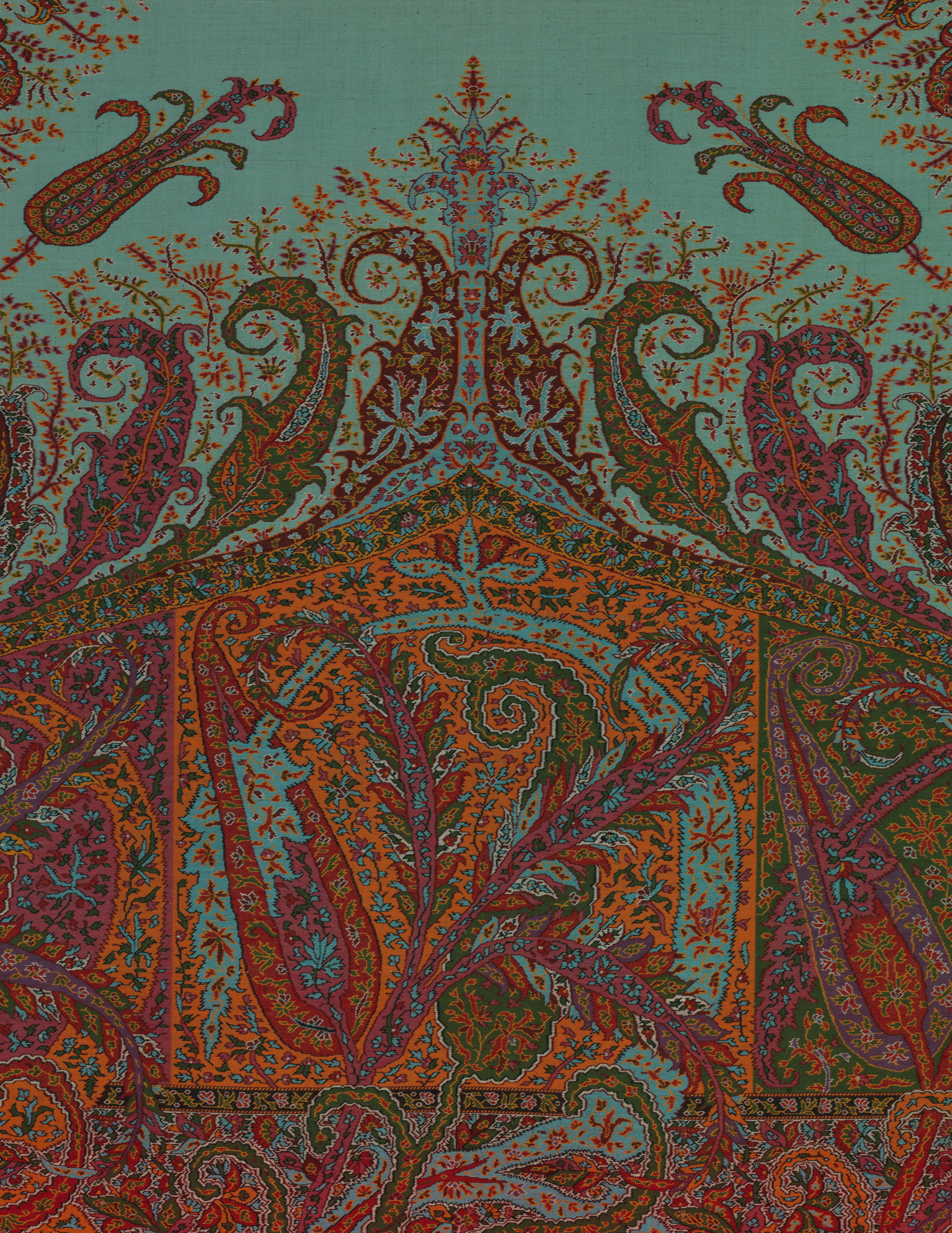
Shawl, mid-19th century, Scottish. Wool and silk, 365.8 x 160 cm. The Metropolitan Museum of Art, New York, 46.136. Public domain.
Although few nineteenth-century textile designs are attributed to their designers, female designers working in the Paisley shawl industry would have prepared patterns such as these.
The majority of the approximately fifty individual female pattern drawers and designers that I have (so far) located in censuses and commercial directories between 1841 and 1881 lived and worked in Scotland – especially in Glasgow and Paisley, reflecting the significance of figured textile manufacturing in both locations. These women and girls designed printed calicos, shawls, and carpets.
While textile design was male-dominated in the Victorian era, working towards a better qualitative and quantitative understanding of women designers refutes historical characterizations of the occupation as exclusively male. It also enhances our understanding of women’s creative work in the nineteenth century. My study of Victorian female designers continues. I am grateful to Women’s History Scotland for supporting this research.
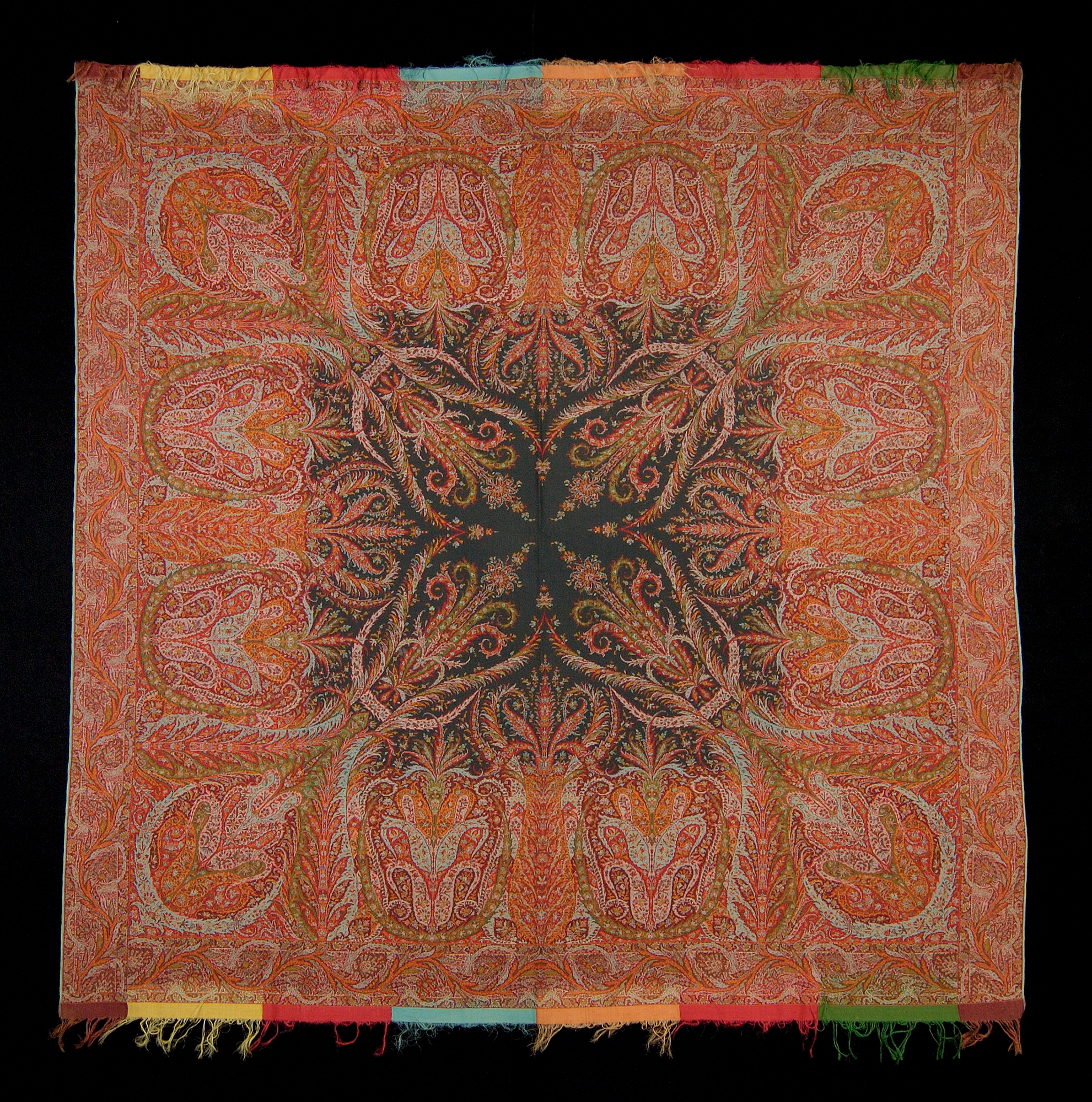
Shawl, 1846, Scottish. Wool. The Metropolitan Museum of Art, New York, 2009.300.5309. Public domain.
Bio:
Dr Sheilagh Quaile is an early-career historian and art historian specializing in nineteenth-century textiles and design. Funded by the Social Sciences and Humanities Research Council of Canada and a Bader Fellowship in Art History, Dr Quaile’s PhD thesis, Paisley, Scotland’s Nineteenth-Century Shawl Designers: Innovators or Imitators? (Queen’s University at Kingston, 2020) investigates the sources, methods, and training of Paisley shawl designers who emulated Kashmiri products. Part of this thesis has been published as an article in the Journal of Design History (2022).
Follow @SheilaghQuaile
To find out more about applying for our Research Bursary, click here
Text copyright © 2023 Sheilagh Quaile
Cite this page as: Sheilagh Quaile, “Female Textile Designers in Britain, c. 1840-1880,” Women’s History Scotland blog (12 April 2023), http://womenshistoryscotland.org/2023/04/08/bursary-winner-report-sheilagh-quaile, accessed [today’s date].
[1] Patricia Zakreski, “Creative Industry: Design, Art Education and the Woman Professional,” in Crafting the Woman Professional in the Long Nineteenth Century, ed. Kyriaki Hadjiafxendi and Patricia Zakreski (Farnham: Ashgate, 2013; London: Routledge, 2016), 153-54. Citation refers to the Routledge edition.
[2] [Henry Cole] “Modern Wood Engraving,” London & Westminster Review 29 (1838): 278.
[3] Report of the Proceedings of the Glasgow Government School of Design at the Fifth Annual General Meeting (Glasgow: Glasgow Courier Company, 1850), 14-15, The Glasgow School of Art Archives, GSAA/GOV/1.
[4] Stuart Macdonald, History and Philosophy of Art Education (London: University of London Press, 1970), 135.
[5] According to a list of Glasgow School pupils’ occupations, female pupils often worked as governesses or schoolteachers, while male pupils were far more likely to be employed as pattern drawers (i.e., designers). Report of… the Glasgow Government School of Design (1850), 12-13, The Glasgow School of Art Archives, GSAA/GOV/1.
[6] Helen Allan in the 1851 Scotland Census, Parish: Paisley Middle Church, ED: 8B, Page: 15, Line: 1, Roll: CSSCT1851_124, Ancestry.ca, accessed 7 November 2022.
[7] Andrew Young in the 1841 Scotland Census, Parish: Paisley Low, ED: 21A, Page: 5, Line: 1020, Ancestry.ca, accessed 25 October 2022; John Allan in the 1841 Scotland Census, Parish: Paisley Low, ED: 21A, Page: 5, Line: 740, Ancestry.ca, accessed 25 October 2022.
[8] Agnes Barr in the 1861 Scotland Census, Parish: Paisley Low Church, ED: 11, Page: 19, Line: 6, Roll: CSSCT1861_80, Ancestry.ca, accessed 29 October 2022; Agnes Barr in the 1871 Scotland Census, Parish: Paisley Low Church, ED: 31, Page: 19, Line: 24, Roll: CSSCT1871_103, Ancestry.ca, accessed 9 January 2023