
Say ‘No’ to the Nuclear Dustbin: the Kathleen Miller Collection at Glasgow Women’s Library
In our latest instalment of ‘Out Gallivating’, Eleanor Peters shares her visit to Glasgow Women’s Library. GWL holds a rich and diverse collection of books, artefacts and archives exemplifying the lives of women, charting their historical and contemporary achievements and contributions, all donated by users, supporters, members and publishers. The archive collects the papers and records of organisations and individuals that represent the achievements and activities connected to women and women’s issues.
Last week, I visited the Glasgow Women’s Library (GWL) to gain some insight into post-war energy transitions in Scotland, with a particular focus on nuclear power. As it was my first visit to GWL, I took the opportunity to explore their collections and exhibitions. Notably, the recently acquired Hunger Strike medal for Maud Joachim, suffragette, and member of the Women’s Social and Political Union (WSPU), currently welcomes visitors at the entrance along with additional illuminating militant suffrage memorabilia.
Zooming forward fifty years, another installation, ‘Teenage Kicks’ offers insight into teenage life in the 1960s. Based on research interviews with eight women, their stories are diverse and challenge conventional narratives of life for young women in 1960s Britain. Candice Purwin’s beautiful illustrations provide an emotive backdrop for this installation.
During my visit, preparations were taking place for an Open Archive event on the theme of ‘Exploring Health’. I could have been distracted by much of the fascinating literature related to this event, but instead, I settled down to the task at hand. I delved into discovering the archive for the anti-nuclear activist, Kathleen Miller.
Kathleen Miller, née George, was born on the 10th of October 1936 in Maybole, Ayrshire. In 1972, Miller became involved in politics, joining the Scottish National Party (SNP), canvassing at elections, and stood as a candidate for the local council. In 1975, much of her activism became focused on challenging the nuclear industry’s plans to investigate the Galloway Hills as a site for the disposal of radioactive waste. As secretary of the Scottish Conservation Society, she helped to fundraise, lobby politicians, organise events, and build a movement that led to a public inquiry into the planning application to test bore at Mullwharchar Hill. Ultimately, in 1982, the campaign won, with plans by the nuclear industry being abandoned.
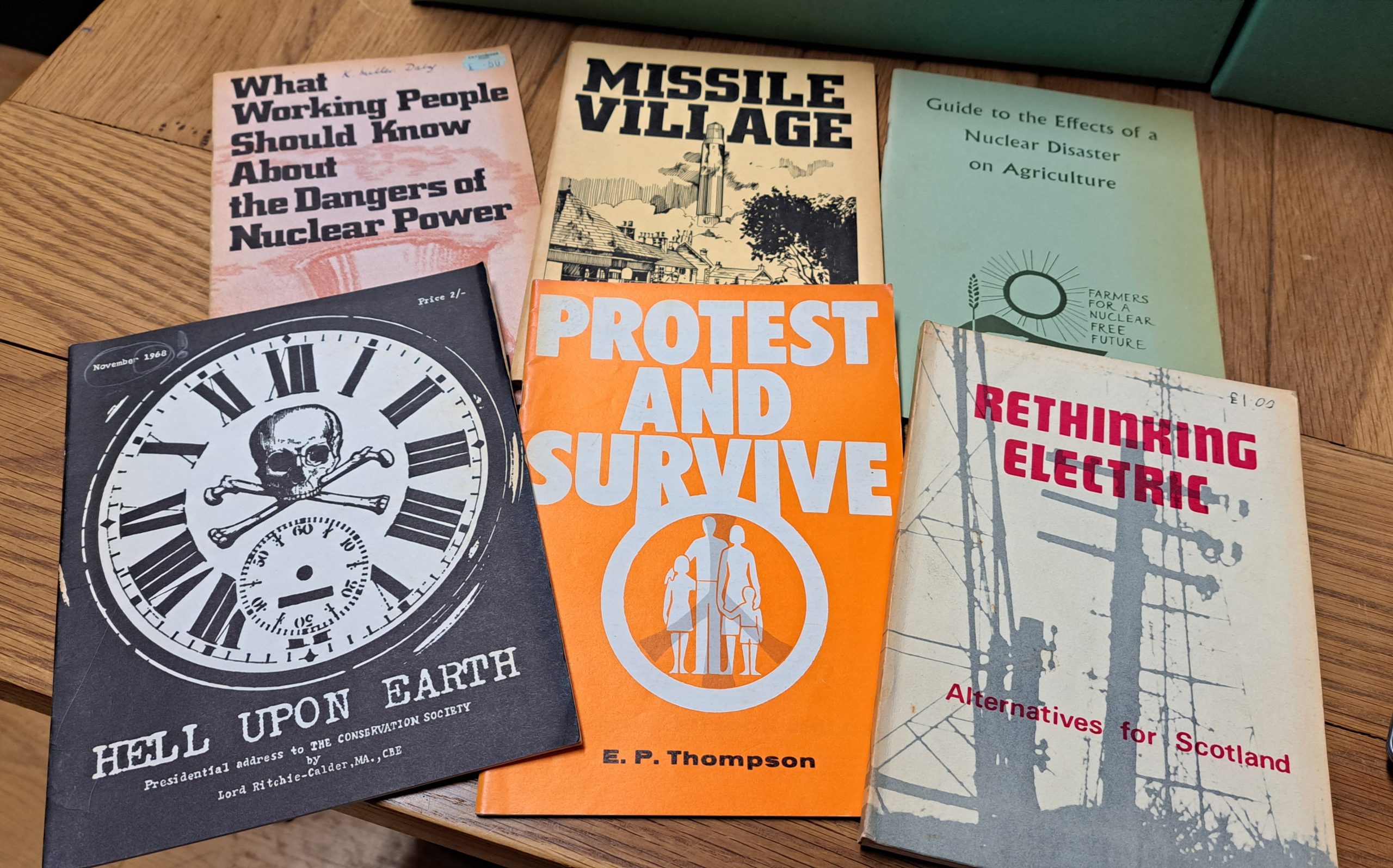
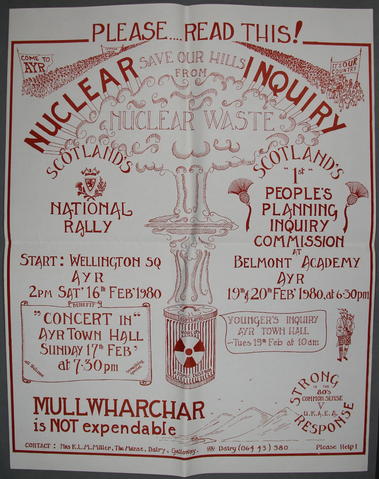
One of the things that struck me most about the collection was Miller’s energetic correspondence. She was dedicated to forging links with the wider anti-nuclear movement in Scotland and the rest of the UK. Miller was also an avid collector of pamphlets, booklets, and other literature related to nuclear power. Much of the literature she collected was technical and disseminated for an audience with experience in the nuclear industry or engineering. She kept reports produced by prominent physicians, such as Dr Alice Stewart, the epidemiologist who demonstrated the link between x-rays of pregnant women and high cancer rates in their children. Other materials in Miller’s collection are political, raising awareness of the work of the Scottish Conservation Society to prevent Mullwharchar from becoming ‘a nuclear dustbin’.[1]
In 1978, Miller contributed an article to Community Council News, citing economic, environmental, and health concerns to support her anti-nuclear stance. Her alarm extended to Britain’s sourcing of uranium in Namibia and Australia. She slammed the hypocrisy of Scottish electricity consumers benefiting from ‘switched-on comfort’ when Australia’s aboriginal communities were being displaced from their lands owing to uranium mining activity – ‘Shed a tartan Crocodile tear for the 20th Century Clearances abroad!’[2]
The Kathleen Miller collection at the GWL has left me intrigued. It demonstrates the holistic approach of anti-nuclear activists during the 1970s and 1980s. Activists critiqued all components of the industry, from the sourcing of uranium to the disposal of radioactive waste, and found it wanting on numerous counts.
[1] Flyers from the National Anti-Nuclear Rally in Glasgow, 1980, KM/2/1/1, GB 1534, GWL archive.
[2] Kathleen Miller, ‘Scottish Conservation’, Community Council News, no. 19 (1978): 16-19, esp. 17, KM/2/2/1, GB 1534, GWL archive.
Text Copyright © 2024 Eleanor Peters
If you wish to read more about GWL’s campaign to acquire Maud Joachim’s Hunger Strike medal, please read this previous WHS blog post by Mairi Hamilton.
Cite this page as: Eleanor Peters, “Say ‘No’ to the Nuclear Dustbin: the Kathleen Miller Collection at Glasgow Women’s Library,” Women’s History Scotland blog (25 April 2024), https://womenshistoryscotland.org/?p=3062, accessed [today’s date]
To contribute to our ‘Out Gallivanting’ blog, please get in touch!