
This report from the archives examines a 1729 childbirth inquiry recorded in the Moneydie Kirk Session records, focusing on the testimony of several local women, including the midwife Katharine Mc’Innes. Their careful and sometimes cautious responses raise questions about the status of women’s knowledge in early eighteenth-century Scotland. What do these records reveal about contemporary attitudes towards women, childbirth, and midwifery before the profession became formalised? The Chappellhill inquiry indicates that women’s knowledge could be indispensable, yet at the same time subject to suspicion, negotiation, and careful examination.
In September 1729, the kirk session of Moneydie travelled to Chappellhill to examine a group of women concerning the “ripeness” of a child.
The inquiry centred upon Anna Talior, whose child had been “brought furth by her upon the eight day of April last.”
The session had received an appointment from the Presbytery of Dunkeld ordering the examination of several women connected to the birth. Among them were Katharine Mc’Innes, a mid-wife in Chappell-hill, together with Janet Miller, Agnes Bade, Isobell Rattray, and Katharine Mackie.
Between 1717 and 1750, only two women were explicitly described as “mid-wife” in the Moneydie kirk session records. Katharine Mc’Innes in 1729 and Christian Archer in 1750.
The meeting itself was unusual. Rather than summoning the women to the ordinary meeting place at Moneydie, the session recorded that “some of those persons cannot travel to this place.”
The minister and elders therefore met “Att Chappellhill the Eighteenth day of September One thousand Seven hundred and twenty nine years”.
The surviving session record does not preserve Anna Talior speaking at length herself. Instead, much of the case survives through the testimony of the women called around her.
One by one they were sworn and “purged of malice and partiall counsell.”
Each was asked whether Anna Talior had “brought furth a ripe child or not.”
The condition of a child at birth could enter the formal process within a kirk session that was deeply concerned with fornication and the timing of pregnancy.
The answers are careful. Their testimony was given under oath and “purged of malice and partiall counsell.”
Katharine Mc’Innes, described as “about sixty years of age,” answered that she “did not know,” because she “was not called to her before the child was born.” She added “this is all she knows in this matter”.
Janet Miller likewise stated that she “was not present at the birth of the child,” having come into the house only afterwards. And therefore “cannot affirm any thing whether the child was ripe or not”.
Katharine Mackie gave similar evidence. She too had not been present at the birth itself, having arrived later with Janet Miller.
Yet her testimony preserves another detail.
Anna Talior, she said, had told her “some dayes before the birth of the child” that she “had gotten a fall at New miln of Logy that might have raised her pains sooner.”
The same explanation appeared again in the testimony of Isobell Rattray.
Unlike the others, she had been present at the birth. Yet still she “doth not know whether it was a ripe child or not,” “not thinking that any question would ever have been proposed about it.”
Women questioned individually before minister and elders.
“did not know”
“was not present”
“cannot affirm any thing”
“doth not know”
The testimony returns again and again as to who was present. Who arrived when and who had been “called” before the child was born. The record is formal and procedural, yet small human details remain visible within it.
A mid-wife “about sixty years of age.”
Women arriving after the birth.
A journey to Chappellhill because some could not travel.
Repeated references to a fall at New miln of Logy.
At the close of the meeting, excuse was made for Agnes Bade, who was “lately brought to bed” and therefore unable to attend. Anna Talior herself was then asked whether she still insisted upon Agnes Bade’s examination.
She answered not.
The session closed with prayer.
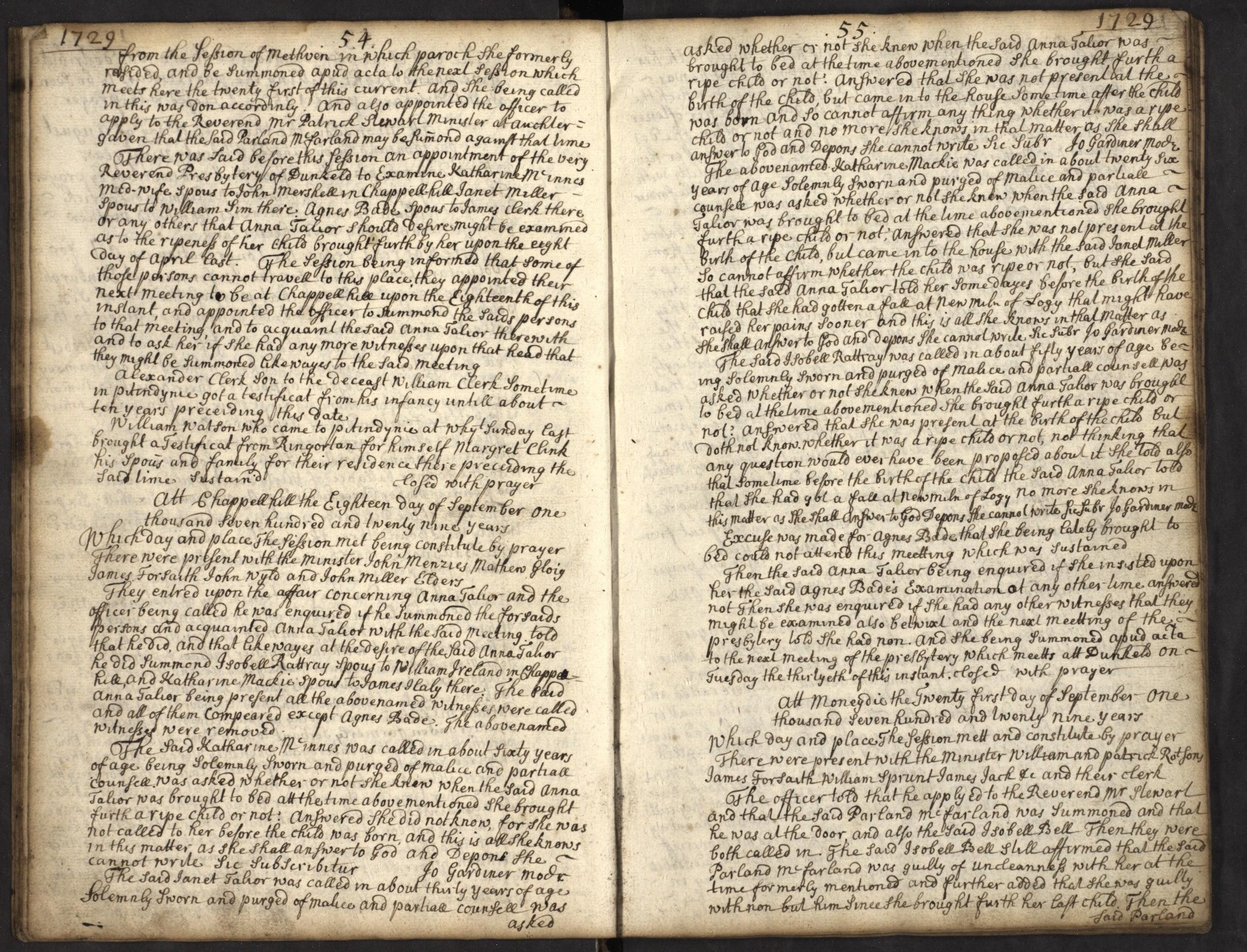
Moneydie Kirk Session Records, CH2/453/1, Chappellhill examination, 18 September 1729.
© Crown copyright. National Records of Scotland / ScotlandsPeople.
Author Biography
Paul Sutherland is a 58-year-old decorator from Edinburgh. His work on the Moneydie kirk session records began while tracing the Peddie name through his mother’s family line, Ina Mathieson Peddie Dent, nee Sutherland. He now focuses on extract-based microhistory, recorded speech, discipline process, and the limits of historical inference within the Moneydie parish records.
Text Copyright © 2026 Paul Sutherland
Cite this page as: Paul Sutherland, ‘“Cannot Affirm Any Thing”: Women’s Testimony and Childbirth at Chappellhill, 1729’, Women’s History Scotland blog (14 August 2026), https://womenshistoryscotland.org/?p=4144, accessed [todays date]
Really enjoyed this Thankyou Paul for your time, curiosity and skills to share this fascinating information.
Thank you. I’m glad you enjoyed it. It is a labour of love. I love trying to show what remains of ordinary lives and hopefully show how women used their agency