
To commence the New Year, we are delighted to host a blog written by Alison McCall, committee member and administrator of Mapping Memorials to Women in Scotland. Alison recovers the life of Catherine MacPhee, whose brother, Angus MacPhee, bludgeoned his parents and aunt to death in the crofting community on the remote Hebridean island of Benbecula.
The latest in the excellent Darkland Tales series is Benbecula by Booker-shortlisted author Graeme Macrae Burnet. It’s a re-imaginging of the events surrounding the murder, in 1857, of Angus and Catherine MacPhee of Liniclate, Benbecula, together with Angus’ elder sister, Mary, by Angus and Catherine’s son, Angus.
Although the murder was all too real, this is, of course, a fictitious account told by unreliable narrator, Malcolm MacPhee, Angus and Catherine’s eldest son.
One line in the Afterword caught my attention. There is a single mention in Malcolm MacPhee’s statement of a ‘married sister’, but it seems odd that no other mention would be made of this sibling and that a statement would not have been taken from her. It seems more likely that this ‘married sister’ was actually a niece of Mary MacPhee’s who is mentioned elsewhere.
Mistakes in the statements were inevitable; the 1891 census includes details of language spoken and Malcolm MacPhee was a monoglot Gaelic speaker. His statement as it appears in the records was in English, and a translation of his actual words. It is, therefore, entirely reasonable to speculate that this only-mentioned-in-passing ‘married sister’ might have been a cousin, rather than a sister. But women who appear to be absent from records or only glimpsed in passing fascinate me; I went off on a quest to find the ‘married sister.’
Her name was Catherine. Her family’s surname in the records varies between McFie, M’Phee, McPhee, MaPhee and McPhie. I will use MacPhee throughout, the spelling used in the novel, unless I am quoting directly from a primary source.
Catherine McFie was living with her parents and siblings, Marion, Malcolm, Angus, John, and a second Catherine in Liniclate in the 1841 census. (The youngest child of the family, Ann was born later in 1841.) The 1841 census gives only names, ages and occupations. There is nothing to confirm that Catherine was Angus and Catherine’s daughter, and the presence of two Catherines in the family may be confusing to those unaware that two children bearing the same name was not uncommon in the Western Isles.
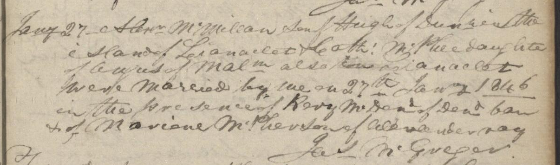
Her marriage certificate, however, makes it clear. Catherine MacPhee of Liniclate, daughter of Angus, son of Malcolm, married Alexander McMillian, son of Hugh, son of Duncan on 27th January 1846. The MacPhees were Roman Catholic and her marriage is recorded in the records of Ardkenneth St Michaels, South Uist, on Scotland’s People.
In the 1851 census she and her husband were living at 30 Liniclate, with their three children, Catherine, aged 4, Roderick aged 2, and 1 month old Catherine. She had followed her parents’ example and named two daughters Catherine. Her parents and brothers Malcolm and John were living at 29 Liniclate and her aunt and sister Marion were living at 32 Liniclate. Her brother Angus was elsewhere and her two youngest sisters, Catherine and Ann, had presumably died.
The Macmillans fourth child, Duncan, was born around 1853, and then Mary on 13 July 1856.
The murder of her parents and aunt occurred in July 1857, when they were killed by her younger brother Angus in a fit of insanity. Catherine lived close to both her parents and her aunt. I have not seen the court records, but Burnet has studied them and says that no precognition was taken from Catherine, which does seem to be a significant, if unsurprising, omission.
Catherine’s sixth child, Ann was born on 17 November 1858 at Torlum Beg, Liniclate, and seventh and last, William, in 1861.
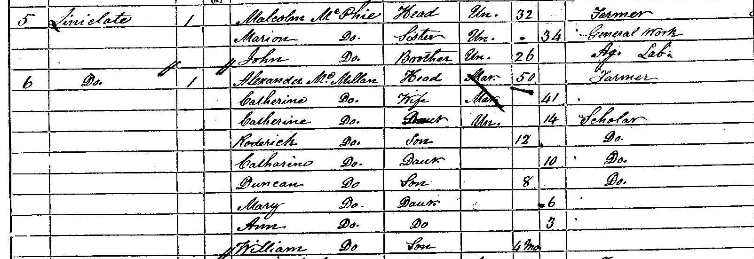
The 1861 census, above, shows Catherine is living with her husband and seven children at Liniclate. Her three younger siblings, Malcolm, Marion and John are in the entry above.
In the 1871 census, she and her husband have five children living at home – both daughters Catherine had left home. In 1881 there were four adult children at home, Roderick (32), Duncan (27), Mary (24) and William (20).
Catherine and Alexander became grandparents in the 1880s. The younger Catherine married in 1883, the older Catherine in 1886, and Roderick in 1887. In 1891, Catherine and Alexander were still in Liniclate with Duncan, Mary, Ann and William. At 78, Alexander no doubt relied on his adult sons to work the croft.
Catherine was widowed in 1902. The Oban Times obituary described her husband Alexander as ‘the oldest male inhabitant in Benbecula’ a man of an ‘amiable disposition.’
It is after this that we get a fuller picture of Catherine MacPhee. She and her community believed that she was born in 1818, and a minister on Benbecula had applied to the King to have her centenary recognised. However, the Oban Times reported, it was an unalterable rule that documentary proof had to be furnished for His Majesty to send a congratulatory message. There was no surviving documentation of her baptism. The closest her family could provide was a record of her youngest brother John’s baptism, and his assertion that she was 17 when he was born.
Was Catherine born in 1818? She gave her age as 37 in the 1851 census, which would have made her even older! But in 1861 her age was given as 41, making her 98 in 1918.

Catherine in the 1921 census was living with her two sons, Duncan and William, next door to her nephew and niece, Malcolm and Kate MacPhee, the children of her brother Malcolm. Catherine’s age is recorded as 103, consistent with her belief that she was born in 1818.
In January 1923 the Oban Times reported that she was 105. She died two months later, on 6 March 1923, almost certainly over 100 years old, although probably not 105! The Ross-shire Journal reported:
Mrs Macmillan lived all her long life in the same township where she was born – Liniclate. She lived in the reigns of George III and IV, of William IV, of Queen Victoria, Edward VII and the present King George.
The Oban Times remarked:
She was a most active woman during her long life time and up to the last retained her mental faculties and memory. She was a small thick-set woman of very sturdy build. She was a great favourite being always so jolly and happy.
The murder of her parents and aunt in 1857 was horrific. But her apparent absence from the legal papers did not mean that she did not exist! She led a full life within the community of Linicate, and in the end it was her remarkable age, rather than the sad fate of her parents and aunt which became noteworthy.
Text Copyright © 2026 Alison McCall
Cite this page as: Alison McCall, ‘Catherine MacPhee and Graeme Macrae Burnet’s Benbecula‘, Women’s History Scotland blog (10 January 2026), https://womenshistoryscotland.org/?p=3901, accessed [todays date]
To contribute to our blog, please get in touch!