
Petra Johana Poncarová is a Marie Curie Fellow at the University of Glasgow. She serves as secretary of the International Association for the Study of Scottish Literatures and is one of the co-directors of Ionad Eòghainn MhicLachlainn | National Centre for Gaelic Translation. Her monograph Derick Thomson and the Gaelic Revival was published by Edinburgh University Press in 2024. Her Scotnote Study Guide on Derick Thomson’s Gaelic poetry appeared in 2020. The project ERSKINE, supported by Marie Skłodowska-Curie Actions, guaranteed by UKRI, and carried out at the University of Glasgow in 2023 – 2025, explores the Gaelic magazines founded by Ruaraidh Erskine of Mar in the first decades of the twentieth century and their impact on the development of Gaelic literature and Scottish national movement.
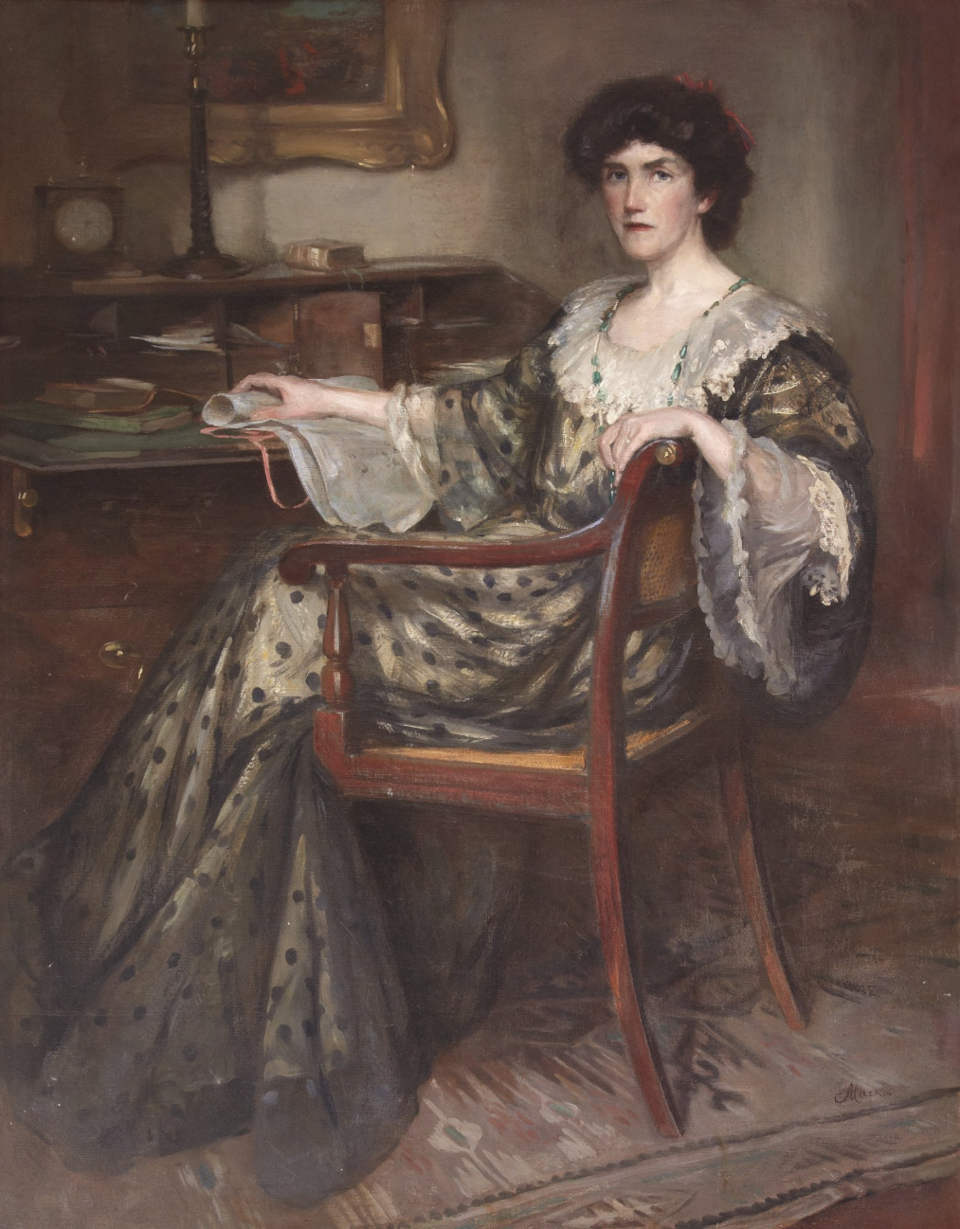
Portrait of Elizabeth Catherine “Ella” Carmichael by Charles Hodge Mackie, c.1902
In the first three decades of the twentieth century, the activist, author, and editor Ruaraidh Erskine of Mar (1869–1960) founded and ran seven periodicals in order to promote the Gaelic language and to further Scottish political independence. Although women contributors to Erskine’s magazines were not numerous, they do include leading writers, scholars, collectors, and activists of the period, from Scotland and beyond. As part of my current research project at the University of Glasgow, I’ve been trying to trace, and, in the case of pseudonyms and abbreviations, identify as many of them as possible, and to showcase their role in the cultural and political initiatives of the time.
An example of an influential Gaelic scholar, editor, and translator is Ella Carmichael | Ealasaid NicGhilleMhìcheil (1870–1928). In 1904–1916, she served as editor of the academic journal Celtic Review and was involved in the foundation of the Celtic Union and of the Women Students’ Celtic Society in Edinburgh. Her contributions to Erskine’s monthly Am Bàrd [The Poet] reveal her interest in Brittany, including translations into Gaelic of poems by François ‘Taldir’ Jaffrennou.
Katherine Whyte Grant | Catrìona NicIlleBhàin Ghrannd (1845–1928) was an author and translator who worked in both Gaelic and English. Her first major project was a Gaelic translation of Friedrich Schiller’s Wilhelm Tell, made into Gaelic from the original German. She was widely travelled and visited, among other places, Romania, South Africa, and Australia. As an author, she focused on Gaelic stories and plays for young readers based on folklore. Erskine’s monthly An Sgeulaiche [The Storyteller] published her play for children ‘An Sgoil Bheag agus a’ Mhaighdean-Mhara’ [The Little School and the Mermaid].
In the spring issue of 1917, the quarterly Guth na Bliadhna [The Voice of the Year] announced the publication of a new poem by Margaret MacKinnon | Mairghread NicFhionghainn (c. 1814 – after 1917) – a poet who was, according to the editorial introduction, born in South Uist in the Hebrides, emigrated to the United States in 1832, and was, at the time of the poem’s composition, 103 years old. The quirky and witty poem ‘Imrich a’ Chait’ [The Cat’s Flitting], written in a traditional vein and intended to be sung, deals with the adventures and travels of a cat. Unfortunately, I have not been able to uncover any biographical detail about MacKinnon or locate more of her writing so far.

Alongside new material, Erskine’s magazines republished older works of Gaelic literature. Mary MacKellar | Màiri NicEalair (1834–1890) was a poet, scholar, and translator. In 1876, she was appointed Bard to the Gaelic Society of Inverness, to which she also contributed scholarly papers. Her Gaelic translation of William Edmondstoune Aytoun’s poem ‘The Execution of Montrose’ appeared posthumously in An Sgeulaiche.
Guth na Bliadhna also featured an early attempt to systematically evaluate women’s poetry in Scottish Gaelic – Malcolm MacFarlane | Calum MacPhàrlain supplied the extensive essay ‘Bàrdachd nam Ban’ [Women’s Poetry] which appeared across three issues (Summer 1913 – Spring 1914).
Louisa Elizabeth Farquharson(1868–1942) was an author and Celtic scholar active in various societies, including An Comunn Gàidhealach [The Highland Association] and the London Gaelic Society. She was involved in Scottish nationalist politics. In her speech at the ‘Scotland’s Day’ demonstration at Stirling on 23 June 1934, which she delivered alongside R. B. Cunninghame Graham and John M. MacCormick, she reached out to women in particular, encouraging them to support the newly founded Scottish National Party.
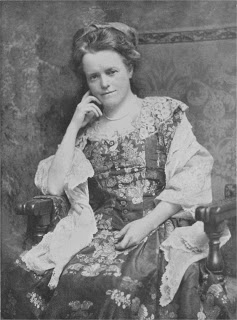
In order to attract a broad readership, Erskine’s magazines regularly featured popular fiction in both Gaelic and English. The very first issue of Am Bàrd published the story ‘“Archies’ Pleesurin’”’ by successful novelist Sarah Broom Macnaughtan (1864–1916). She travelled internationally, participated in charitable and social causes, and volunteered with the Red Cross in the First World War. The story was later appeared in The Cornhill Magazine (February 1909).
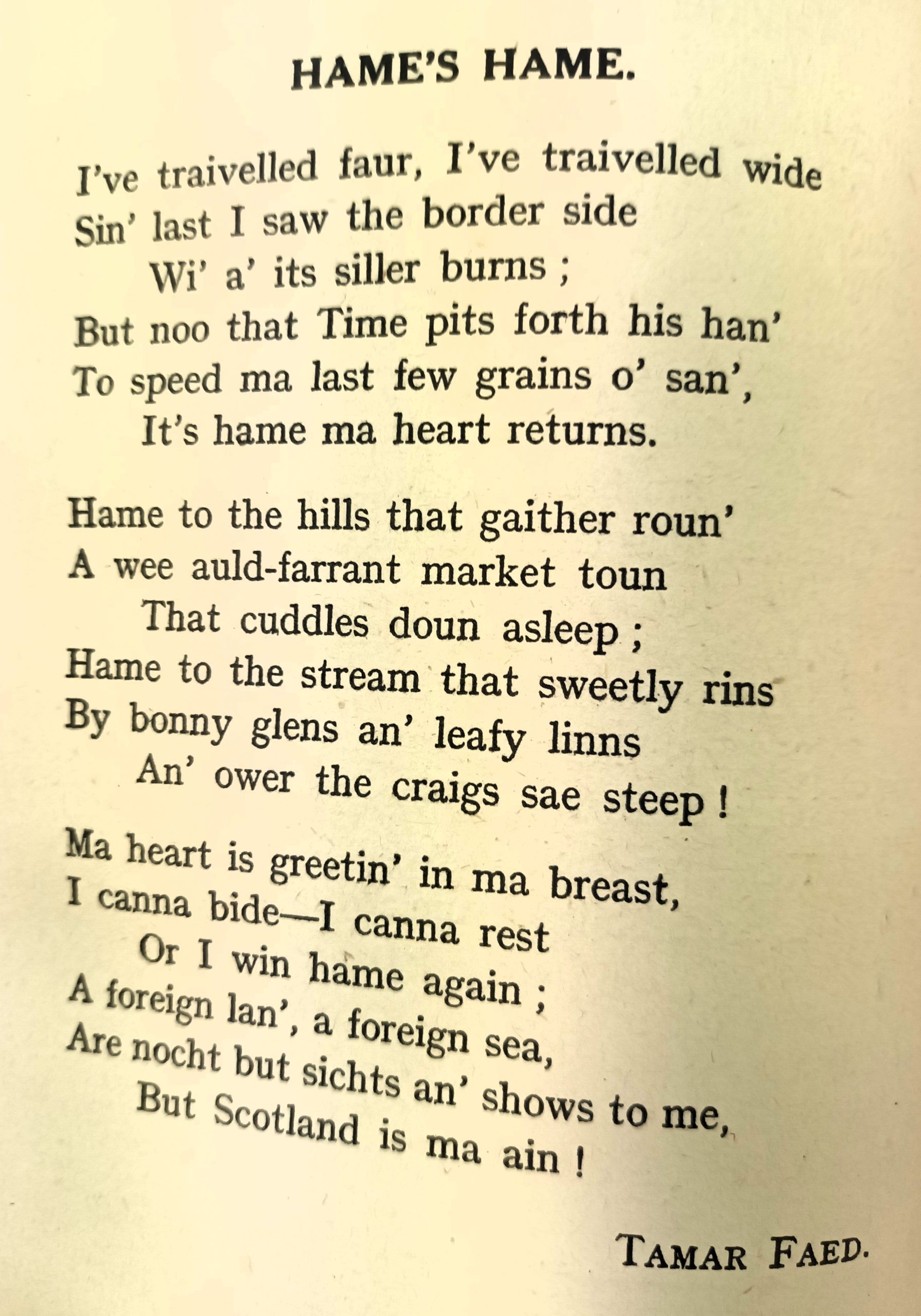
An isolated poem in Scots, ‘Hame’s Hame,’ stands out among the contents of Guth na Bliadhna. Included in the autumn issue of 1917, it was signed by the pseudonym ‘Tamar Faed.’ According to a note accompanying the poem ‘The Scottish Wife’s Complaint,’ ‘Tamar Faed’ was the pseudonym of Isobell Marchbank.[1] Marchbank wrote in both Scots and English. Her poetry appeared in The Scottish Chapbook, a magazine edited by C. M. Grieve (Hugh MacDiarmid), in the anthology Oor Mither Tongue (1938), and was set to music by composers including Robert McLeod, Cyril Scott, and Herbert Matheson Goldstein.
It was most likely Grieve’s contacts that brought another woman writer to The Pictish Review, one of the two journals which Erskine edited and which were predominantly Anglophone but also featured Gaelic writing, translations from Gaelic, and articles concerning Gaelic topics. Olive Maud Squair (1902 – after 1978) came to write a piece for it. She worked as a journalist, supported Scottish independence, and her publications include Scotland in Europe (1976), to which Grieve provided an introduction, and A Tale to Tell (1970). She corresponded with Grieve, and the letters are held by the University of Edinburgh Special Collections.
The research is ongoing, and a growing list of women contributors involved in Erskine’s magazines is available from the project website. If anybody has more information on the women involved, especially Margaret MacKinnon, Olive M. Squair, and Isobell Marchbank, I’d be keen to get in touch.
[1] Poetry of To-day: The Poetry Review New Verse Supplement II: 4 (July – August 1920): 111. I am grateful to Dorian Grieve for identifying ‘Tamar Faed’ as Isobell Marchbank and for providing me with the precise reference that resolved the mystery.
Text Copyright © 2025 Petra Johana Poncarová
Bluesky: @erskineproject.bsky.social
Facebook: https://www.facebook.com/erskine.magazines/
Cite this page as: Petra Johana Poncarová, ‘Women Contributors in Ruaraidh Erskine’s Magazines’, Women’s History Scotland blog (21 April 2025), https://womenshistoryscotland.org/?p=3691, accessed [todays date]
To contribute to our blog, please get in touch!