
The Real Housewives of Scotland: Invention, Innovation and Energy Saving at the Turn of the Twentieth Century
What does a woman really want for Christmas? A cinder sifter and an ornamental stove, of course! This month’s guest blog has been written by Lucy Wood from Queen’s University Belfast. Lucy is presently researching her PhD thesis which focuses on how ‘ordinary’ women in the home dealt with the transition from coal to gas and electricity, around the turn of the twentieth century. Not only did this generation have to learn how to manage new sources of fuel, but they also had to navigate and master new forms of technology and adapt to new practices and routines. What this research reveals is that, rather than being passive users of male-designed equipment, women in the home were constantly adapting and innovating household technologies to improve their usability or efficiency. This blog focuses on four such women, all from Scotland, who adapted and patented different types of domestic technology.
Fuel economy, environmentally-friendly practices and health and safety are all concepts which we tend to associate with our modern world. However, whilst researching female patent applications – still a considerably under-explored resource – I discovered that these are, in fact, long-standing concepts which were all embraced and promoted by women in the home well over a century ago.
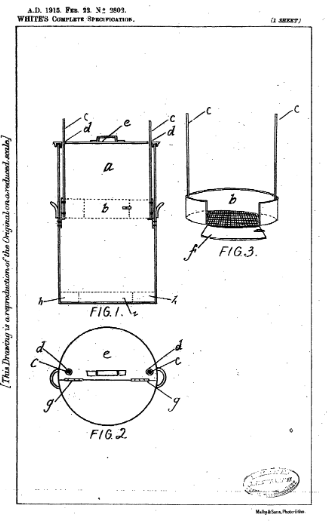
Mary White, for instance, from Glasgow, had fuel-economy in mind when she patented her revised form of cinder-sifter in 1915.[1] Cinder sifters were used to collect and sift the ash and cinders from the fireplace or kitchen range, identifying any larger lumps of coal which could be reused. They were therefore commonplace utensils within most homes. Mary’s design appears to be immensely practical; she designed a sieve which would be held securely within a portable container and shaken by two exterior handles. By this method the cinders could be efficiently separated with any dirt or dust safely contained. Her patent specification stated that to ‘save cinders is one of the most obvious of household economies’ reflecting contemporary sensibilities towards fuel economy. In this sense, cinder-sifters were a precursor to our modern energy-saving practices in the home, such as turning down the thermostat.
An alternative means of reducing fuel consumption was displayed by Violet Stuart from Montrose. Violet registered several patents, including two rather large, seemingly complex, combined stoves and heaters. The first of these, registered in 1921, was for a multi-purpose coal-fired stove, which could be adapted and fitted into any ordinary coal fireplace.[2] This stove was ‘of suitable appearance for use in a living room but capable of being readily converted into a stove suitable for performing the functions of a kitchen range’.
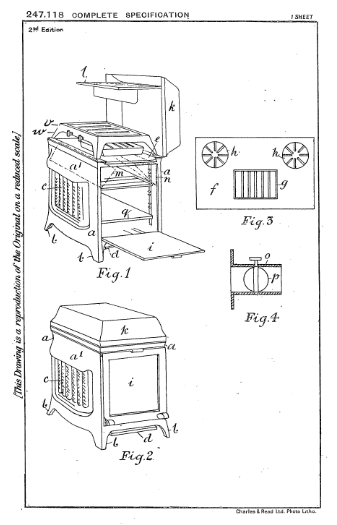
Adaptability therefore appears to be the main impetus behind her design; it could be used as a kitchen range for cooking, as a means to produce hot water and dismantled to make a portable heater to be moved between rooms and was therefore ‘capable of warming the whole house’. Violet’s subsequent patent, in 1925, adapted this stove for use with either gas, electricity or oil, highlighting the fluidity of domestic energy sources at the time.[3] Possibly reflecting her upper-class status, Violet displays considerable concern over the aesthetics of her designs, a worry few working class patentees exhibited. She claimed her stove was of ‘ornamental appearance’ which, whilst it was being utilised to warm a sitting-room or other room in the house, gave no indication of its hybrid nature as a functioning kitchen range. This reveals a sense of embarrassment around kitchen technology, which she infers should be hidden from other occupants, or, more probably, visitors to the house. It also highlights a sense of hierarchy within the home over certain practices; cooking and functions performed on the kitchen range clearly have a lower status to an ornamental sitting-room heater, which was more acceptable in polite company. Violet’s hybrid invention is therefore not only practical and energy efficient, but it also displays a strong focus on interior design, and reveals class snobberies over certain household technologies. How much the servants (who would have been tasked with actually using this as a functioning kitchen range) would have really cared about its outward appearance, is debatable.
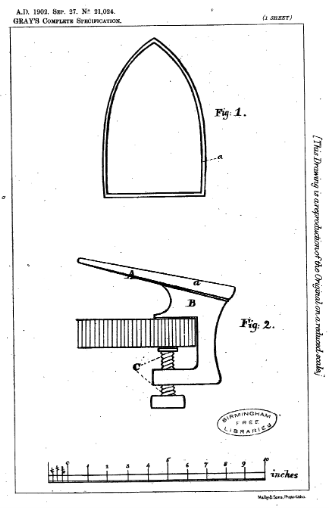
Our third female patentee, Janet Gray, had health and safety firmly in mind when she patented her safety stand for domestic irons in 1902.[4] Her stand was designed to be screwed to the table, at a slight inclination and had a deep flange to securely hold the hot iron. Her specification states that the object of her invention ‘is to diminish the liability to accident in … the breakage of irons, or scorching, or burning’. Janet was married to an Edinburgh Doctor so she may well have been exposed to the reality of burns and scalding within her husband’s local practice. Burns remained one of the foremost domestic dangers but the subsequent expansion of gas and electricity within the home added additional fears and anxieties onto the shoulders of women, who bore the main responsibility of keeping their family safe.
Our final patentee, Robina Wood, attempted in 1894 to employ natural resources rather than manpower, to dry dishes, unwittingly exhibiting a rather modern environmentally-friendly approach. Robina devised a very simple method of efficiently drying dishes and cutlery naturally in the air rather than expending either physical energy or fuel sources.[5] Her invention was essentially a simple rack for placing the wet utensils on, which had a drainage gutter and waste pipe beneath, and could be wheeled to suitable drying locations, if necessary. Whilst her invention was predominantly intended for use in hotels and restaurants, she stated it could also be used in ordinary household kitchens. This simple innovation mirrors our modern desire to find less carbon-intensive solutions for everyday tasks.
Frustratingly we know very little about these women. In common with most ordinary women of their time, apart from a few fleeting entries in census returns, they have become virtually invisible. Janet Gray is the most identifiable of the four, and we know she came from a middle-class, professional home. Mary White was the second wife of a cabinet maker in Glasgow, taking on the care of his six children, as well as their own two daughters, with no servants listed on the 1901 census records. Having such a large family no doubt made fuel economy an even more pressing priority. Disappointingly, there is no further trace of them on the 1911 census. Records for Violet Stuart are even more scarce as she is virtually untraceable in any online census records. She appears to have been at the top end of the social scale as she was documented on several patent applications as the Countess of Sobanska. Robina Wood is likewise a bit of an enigma. Her patent application unusually does not detail her marital status but census records from 1881 to 1901 note her as married, but also as the head of the household. No husband is present on any of these census reports and no marriage certificate has been traced for her. She already had three children in 1881 but gave birth to another daughter in 1889, despite having no obvious husband present, although various male lodgers and visitors were also listed, reflecting her documented occupation as a boarding house keeper.
What these four patentees have highlighted is how women from varying social and economic backgrounds could share the same spirit of innovation and drive. Patents by women still only amounted to around 2% of overall applications at this time, so women continued to be marginalised in the male-dominated world of invention.[6] Male patentees were often identified on patent applications as an inventor or engineer, but female patentees were, instead, classified as married women, spinsters, gentlewomen, the occasional dressmaker or other acceptable female profession, but rarely as ‘inventor’. Two out of our four Scottish women, however, pushed back against convention. Robina Wood was noted on her patent application as an inventor, which is extremely rare. As the acknowledged head of the household, Robina possibly had more self-confidence in her abilities to provide for her family and recognised her own status. Violet Stuart also exhibited considerable self-confidence and independence as she noted herself as a ‘lecturer and inventor’ on an earlier patent and a company – Stuart-Sobanska’s Inventions Limited – was subsequently set up with the intention of manufacturing her portable stove.[7] These patentees, however, were the exception to the rule. How Society identified and categorised female patentees and how they self-identified highlights the contemporary marginalisation of women’s work and women’s innovation but is also testament to women’s persistence at pushing back.
As well as being ‘housewives’, these women also demonstrated expertise as inventors, interior designers, energy managers and in areas of health and safety. This innovation and user-based adaptation of domestic technology, which was quietly carried out in households throughout the country, has been overlooked and marginalised for far too long and, I feel, deserves to be properly acknowledged and celebrated.
[1] Mary Shields White, A Riddle bin for the Purpose of Saving Cinders, GB191502802A, application date 22 Feb., 1915.
[2] Violet Stuart, Improvements in and relating to stoves for heating and cooking purposes, GB186753A, application date 27 July, 1921.
[3] Violet Stuart, Improvements in and relating to stoves, GB247118A, application date 9 Oct., 1925.
[4] Janet Gray, A Safety Stand for Gas Irons and other Irons, GB190221024A, application date 27 Sept., 1902.
[5] Robina Wood, Improvements in and relating to the Drying of Dishes and the like, GB189410066A, application date 24 May, 1894.
[6] Stephen Van Dulken, British Patents of Invention,1617-1977: A Guide for Researchers (London: British Library, 1999), p.84.
[7] Violet Sobanska, A Portable Collapsible Heating and Cooking Apparatus, GB191504298A, application date 19 Mar., 1915. Stuart-Sobanksa’s Inventions Ltd was incorporated in January 1922 but dissolved in 1925; The National Archives, BT 31/26988/179114.
Text Copyright © 2024 Lucy Wood
Cite this page as: Lucy Wood, ‘The Real Housewives of Scotland: Invention, Innovation and Energy Saving at the Turn of the Twentieth Century’, Women’s History Scotland blog (02 December 2024), https://womenshistoryscotland.org/?p=3465, accessed [todays date]
To contribute to our blog, please get in touch!