
The Scientific Work of Maria Graham and Marian Farquharson
This month’s blog has been written by Eleanor Gillespie, a recipient of the Women’s History Scotland Bursary in 2023. Eleanor is a PhD student at the University of Portsmouth researching the contributions of women to the study and culture of ferns in the long nineteenth century. Her PhD takes an interdisciplinary approach, combining literary analysis with gender history, the history of science and environmental history. Her research aims to rehabilitate the role of women in the study of pteridology and provide a case study for women’s roles in nineteenth century science. In this blog she uncovers the work of two fascinating nineteenth-century women, Maria Graham and Marian Farquharson.
The Women’s History Scotland Bursary supported my travel to London to visit the archives of the Royal Botanic Gardens, Kew and the Linnean Society. This trip allowed me to spend time working with important archival material for two women who feature in my PhD research, Maria Graham and Marian Farquharson, whose experiences in Scotland were fundamental to their scientific development. Working at opposite ends of the nineteenth century, they challenged conventions through their scientific work.
Born Maria Dundas in 1785, Maria Graham was an early woman travel writer who published on her experiences in India, Italy, Chile and Brazil. She spent a year in Edinburgh between 1804 and 1805, where she entered the social circles of key figures of the Scottish Enlightenment, including John Playfair.[1] It was here that she gained the nickname of “Metaphysics in Muslin” and her interest in science was fostered.[2] In her published work, Graham makes several references to her botanical interests, particularly in her Journal of a Voyage to Brazil, where she illustrates the famous Green Dragon Tree of Oratava, on the island of Tenerife.[3] However, it is only when attention is turned to archival material that Graham’s true scientific impact can be explored.
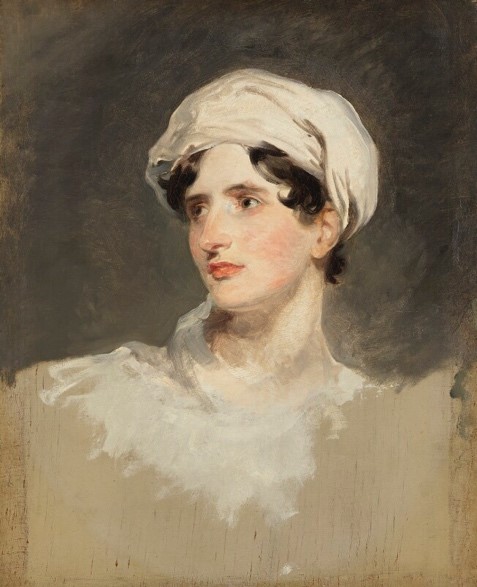
Of particular interest to my research is the time which Graham spent alone in Brazil between 1824 and 1826, a period which is documented in the archive of the Royal Botanic Garden, Kew. The archive includes letters written by Graham to William Jackson Hooker, who was then Professor of Botany at the University of Glasgow, and botanical illustrations made by Graham in Brazil. This collection of correspondence provides vital glimpses into the botanical work which Graham undertook in Brazil. Within her letters, she references the botanical specimens which she collected for Hooker near her home in Laranjeiras and describes the practical challenges she faced in drying specimens in the hot and humid climate.[4] Her correspondence with Hooker reveals a two-way transfer of knowledge, Hooker sending Graham books from Britain and Graham sending him specimens and showing him her botanical illustrations.[5]
These archival materials help to highlight Graham’s place within a network of European botanists. Within this space she was regarded as an important source of knowledge on the flora of Brazil, her illustrations praised by botanist John Sims.[6] She was also credited within the published work of numerous botanists, including Hooker, for supplying specimens or illustrations.[7] Being able to view a selection of Graham’s original illustrations at RBG Kew was particularly special, as it allowed me to begin to document what kinds of plants she was illustrating and the scientific study which went into her work.
I was also able to visit the archives of the Linnean Society to further explore the work of Marian Farquharson, her relationship with the Society and her efforts to gain admission for women Fellows. Born Marian Ridley, she published A Pocket Guide to British Ferns in 1880 and following her marriage and move to Alford in Aberdeenshire, publishing her work in The Scottish Naturalist and presented a paper at the British Association for the Advancement of Science in 1885.[8] It was during her time in Scotland, following the death of her husband, that she began to campaign for women’s full admission to the Linnean Society. She was a supporter of women’s rights and was President of the Scottish Association for the Promotion of Women’s Public Work.[9]

Marian Farquharson’s formal petition to the Society in 1901 described both her demands and the support she had already received from existing Fellows. She believed that women who were “fully qualified by their knowledge of Botany and Zoology” should be eligible for Fellowship.[10] Her petition reveals her determination that women should be eligible to full Fellowship and thus equal to male members. By the time her petition was sent to the Linnean in 1901 she had gained the support of prominent members of the Linnean Society, including the Vice-President C. Baron Clarke and the Secretary of the Royal Society Sir Michael Foster.[11]
However, Farquharson faced serious opposition, with one member calling for her to be blackballed from the Society.[12] Sixteen women stood for election in 1904. Fifteen were elected, and Marian Farquharson was rejected.[13] She was finally elected to the Linnean Society in 1908, her Certificate of Recommendation signed by three of the women who had gained admission in 1904 thanks to her efforts: Grace Frankland, Catherine Crisp and Ellen Willmott.[14] However, due to ill health, she was never able to visit the Linnean to sign the Declaration, and died in 1912.[15]
I am incredibly grateful to Women’s History Scotland for supporting this archival research. The Research Bursary allowed me to explore this vital material which provides new insights into the lives of two women whose contributions to nineteenth century science have been underappreciated. I am currently in the second year of my PhD and am looking forward to incorporating this research into my thesis.
Eleanor Gillespie is a PhD student at the University of Portsmouth researching the contributions of women to the study and culture of ferns in the long nineteenth century. Her PhD takes an interdisciplinary approach, combining literary analysis with gender history, the history of science and environmental history. Her research aims to rehabilitate the role of women in the study of pteridology and provide a case study for women’s roles in nineteenth century science.
[1] Regina Akel, Maria Graham: A Literary Biography, (Amherst: Cambria Press, 2009), 19.
[2] Rosamund Brunel Gotch, Maria, Lady Callcott, (London: John Murray, 1937), 75.
[3] Maria Graham, Journal of a Voyage to Brazil: and residence there during part of the years 1821, 1822, 1823, (London: John Murray, 1824), 83-85, accessed July 18, 2024, Google Books.
[4] Letter from Maria Graham to William Jackson Hooker, January 30, 1825, Directors’ Correspondence 43/49, Library and Archives at Royal Botanic Gardens, Kew, London, United Kingdom.
[5] Letter from Maria Graham to William Jackson Hooker, April 11, 1824, Directors’ Correspondence 43/20, Library and Archives at Royal Botanic Gardens, Kew, London, United Kingdom.
[6] John Sims, Curtis’s Botanical Magazine; Or, The Flower-Garden Displayed, Volume 53, (London: Sherwood, Gilbert & Co., 1826), accessed October 24, 2023, Biodiversity Heritage Library.
[7] W. J. Hooker and G. A. W. Arnott, “Contributions Towards a Flora of South America and the Islands of the Pacific”, Botanical Miscellany 3, (1833): 129, accessed October 13, 2023, Biodiversity Heritage Library.
[8] Peter G Ayres, “Marian Farquharson and the Struggle for Admission of Women Fellows”, Linnean Special Issue No. 10, ‘The Door Was Opened’: Pioneering Women at the Linnean Society of London and Their Continuing Legacy, (2023), 22.
[9] Sarah Pedersen, “The appearance of women’s politics in the correspondence pages of Aberdeen newspapers, 1900-1914”, Women’s History Review 11, no.4, (2006): 663, accessed July 18, 2024, https://doi.org/10.1080/09612020200200343.
[10] “Admission of Women”, Marian Farquharson, 1901, DA/ENG/1/7, Archives of the Linnean Society, London, United Kingdom.
[11] Ibid.
[12] Letter from M. Hartog to the Linnean Society, November 11, 1900, DA/ENG/9/BL/3/8, “General Linnean Society Correspondence Volume III: 1893-1904, Archives of the Linnean Society, London, United Kingdom.
[13] Gina L. Douglas, “Introduction”, Linnean Special Issue No. 10, ‘The Door Was Opened’: Pioneering Women at the Linnean Society of London and Their Continuing Legacy, (2023).
[14]‘Certificate of Recommendation, 1908, Marian Farquharson”, DA/ENG/1/CR/121, Archives of the Linnean Society, London, United Kingdom.
[15] Ayres, “Marian Farquharson and the Struggle for Admission of Women Fellows”, 27-28.
Text Copyright © 2024 Eleanor Gillespie
Cite this page as: Eleanor Gillespie, ‘The Scientific Work of Maria Graham and Marian Farquharson’, Women’s History Scotland blog (26 July 2024), https://womenshistoryscotland.org/?p=3256, accessed [todays date]
Twitter: (21) Eleanor (@eleanor_19thC) / X
To contribute to our blog, please get in touch!