
We are delighted to host a guest blog this month written by Catriona Davidson, curator of the Glencoe Folk Museum. In the 1960s, the museum was founded by Miss Barbara Fairweather MBE, Mrs Rae Grant and friends. After entering a Women’s Rural Institute competition which asked applicants to tell the history of their village, they realised that not much information had been recorded about daily life in the past. In this blog, Catriona gives insight into Barbara’s character and her role as a founder of the Glencoe Folk Museum. Glencoe Folk Museum is proud to be founded, run and supported by women!
“We thought that ‘they’ ought to make a museum to record daily life. But ‘they’ do not exist…so we did it ourselves.”
So said Barbara Fairweather MBE when asked why she and her friends founded Glencoe Folk Museum. In 1966, in preparation for the Scottish Women’s Rural Institute’s golden jubilee, groups were invited to take part in a competition to write their village history. As secretary of the local SWRI, Barbara took on this task with her customary passion, speaking to the older residents of the village, gathering their stories and memories and persuading them to dig around in their loft for forgotten artefacts. Although they did not win the competition, the ladies did realise how rich the history of the area was and how little of it had been recorded outside of well-known events such as the Massacre of Glencoe. They decided to rectify this by creating the Glencoe and North Lorn Folk Museum. Barbara got some friends together to form a committee, and they put the call out for donations via posters and adverts on travelling vans. They raised money through ceilidhs and bake sales, a small cottage in Glencoe Village was secured, and the Museum opened in June 1967.

For the next 30+ years, Barbara Fairweather was the backbone of the Museum. Her dedication and passion for local history established it as one of the best small museums in Scotland, and she also wrote and published many informative booklets on a huge variety of subjects including folklore, forestry and plants. These were later compiled into a larger book entitled ‘Highland Heritage’, which won the publication award at the Museum of the Year Awards in 1986. She was awarded an MBE in 1994 for “services to the arts”, which she very modestly said was “not just recognition of my work, it is for all the people who have worked on a voluntary basis at the Museum over the years”. Glencoe Folk Museum was built around Barbara’s love of Glencoe, her passion for local history, her belief that no object is too humble and her delight in sharing knowledge, and this is still very much at the heart of what we do.

Barbara Francis Fairweather was born on the 20th May 1917 in Cathcart, Glasgow and spent much of her life as housekeeper and later nurse to her father, Wallace Cranston Fairweather, a Chartered Patent Agent. Not much is known about her earlier life, though it appears as though the family were relatively wealthy, living in Glasgow’s affluent Kensington Gate and at one point employing three servants. During the Second World War, the young Barbara Fairweather welcomed refugees into the family home and received a letter from Queen Elizabeth thanking her for services to her country. Barbara went on to join the Civil Defence Corps in the 1950s, training in Welfare and First Aid and later becoming a part-time Welfare Instructor in Argyll.
Despite growing up in the city, Barbara had Highland blood in her veins and had always loved the Glencoe area, so after her father’s death in 1959 (following the death of her mother in 1950) she fulfilled a lifelong dream by moving north – first to Duror and then to Invercoe. As she later told friends, she felt that she had come home. It was just a few years later that she took on the job of writing the history of Glencoe for her local SWRI group, and the rest is (literally) history.
The Museum took up most of Barbara’s time. When she wasn’t running the desk herself, organising volunteers, writing letters to secure funding or contributing articles to Scottish history magazines, she was seeking out new objects for display. She jokingly called herself “Scrounger” Fairweather as she was always on the lookout for anything to add to the Museum collection. In the winter months, when the Museum was closed, objects would be decanted to her house at Invercoe and she would spend her time cleaning, polishing and maintaining the thousands of items. But she didn’t grudge a minute of this time spent preserving local history: “I’m a very lucky woman to be able to spend my life on work which gives me so much pleasure” (Clan MacDonald USA, April 1980). She would often invite visitors back to her house for tea, where she would regale them with stories of the area, and they could browse the exhibits. Locals particularly remember both the joy and trepidation of exploring her old house as children, coming face to face with a taxidermy eagle on the staircase or peering through the windows of a doll’s house.
Despite her tireless work for the Museum, she still found time for other ventures. She always loved birds, and so set up a Saturday morning Bird Club for children. One local lady attributes her life-long love of nature and wildlife to weekends spent identifying birds in the woods around Barbara’s house. In fact, Barbara loved all animals, and was often seen out and about walking her elegant Afghan Hounds. In later years, she had a cat called Amber, who was the subject of many adventure stories that Barbara penned for her nephew, Michael.
She became a much-loved and familiar figure around the village, always dressed the same (tweed skirt, stockings, blouse and cardigan) and known as Babs to her friends – of which there were many! The number of book dedications, gifts and letters that she received from all over the world are testament to her popularity. She was generous both with her knowledge and her possessions, lending books to visitors and happily sharing her “treasures” with others. It is likely this generosity of nature that contributed to her desire to build the Museum; once she discovered something – whether it was a story, a fact, or an important historical object – she wanted others to have access to it as well, to share in the joy of learning and the uncovering of our past.
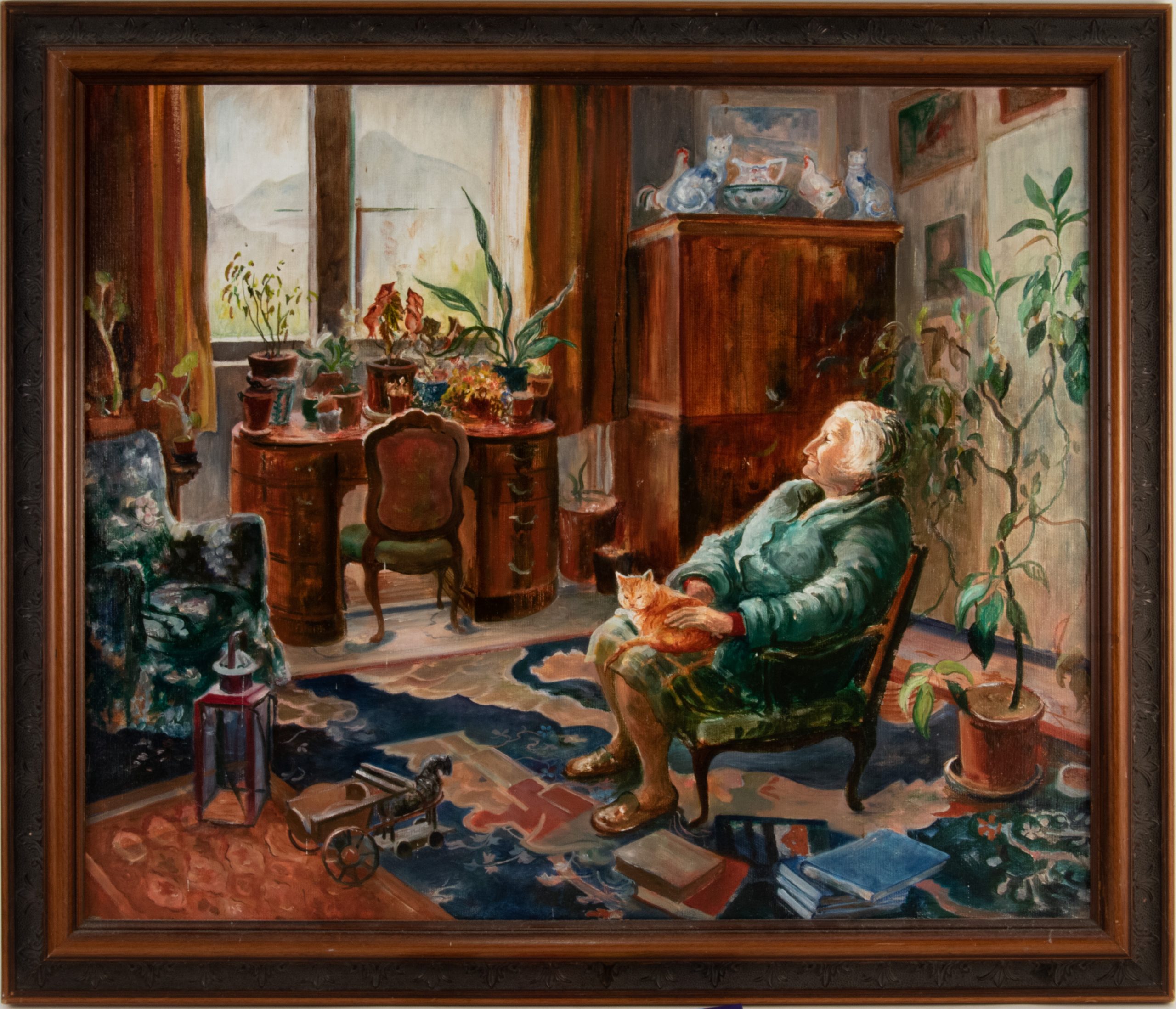
Upon her retirement from the Museum in 1999, Barbara was presented with a portrait of herself sitting at home, surrounded by Museum objects and books (including Highland Heritage), and with Amber in her lap – an image that seems to sum her up perfectly. Despite officially stepping back from her role as secretary-treasurer, Barbara remained involved in the Museum until her death in 2001.
And still her legacy lives on. We continue to sell her pamphlets on local history in the Museum’s gift shop, and they are a respected resource for research. The Redevelopment Project that we are currently undertaking will see us install the Museum’s first toilets, create a community hub and extend the exhibition space – all dreams that Barbara herself had for the future of the Museum. We will also have a display dedicated to the Museum founders entitled “Our Roots”, telling Barbara’s story and highlighting the role that this special lady played in preserving so much of the area’s history for future generations.
I feel immensely privileged to be continuing the work that she started.
Further reading and resources: ‘Highland Heritage’ is tricky to come by online but can still be purchased directly from the Museum, along with most of Barbara’s original booklets. The Museum of the Highlands website offers some fantastic resources for children and features Barbara in one of their “Stories of Life”.
Text Copyright © 2024 Catriona Davidson
Cite this page as: Catriona Davidson, ‘Recording Daily Life: The Work of Barbara Fairweather, founder of the Glencoe Folk Museum’, 13 June 2024, https://womenshistoryscotland.org/?p=3256, accessed [todays date]
Twitter: https://x.com/Glencoe_Museum
To contribute to our blog, please get in touch!