
This month, we are delighted to host a guest blog from Dr Lindsay Middleton, a literary historian of nineteenth-century food writing, and Knowledge Exchange Associate for the College of Arts and Humanities at the University of Glasgow. Dr Middleton’s research focuses on the literary qualities of recipes and cookbooks, analysing the representation of culinary technologies to understand how nineteenth-century authors situated themselves in the past, present, and future. Her work ranges from the history of tinned foods to the publications of Victorian chefs Agnes Marshall, Alexis Soyer, and Georgiana Hill. She also researches Scottish food history, and invalid cookery in the Scottish context. As Knowledge Exchange Associate, Dr Middleton works with a range of researchers and industry stakeholders to create impact and partnership opportunities. In particular, she is interested in the ways that Arts and Humanities research can help transform the Scottish food industry, and food’s potential within heritage properties.
For as long as recipes have been recorded in writing, be that in early manuscript recipe collections or in printed cookbooks, there are visible links between food and health. Recipes for roasted meats and biscuits sit alongside recipes for tinctures and curatives like ‘Daffy’s Elixir’; a brandy based herbal infusion for curing stomach problems, that could be bought or prepared in the home. Indeed, until the mid-twentieth century printed cookbooks typically contained a chapter on ‘Invalid Recipes’. Most of these were typically bland and soft foods that would be easy for ill people to digest, and would provide the nutrients required for healing. Today there is a wealth of food writing that ties into ideas of illness and health, from ‘clean eating’ and fad dieting to ‘superfoods’. It is no longer common, however, for cookbooks to contain ‘Invalid Recipe’ sections.
This two-way relationship between food and medical treatments meant that the domain of medicine and health was not separated from the kitchen, home, or domestic practice in the same way it arguably is now. Moreover, the historical expectation that the home was a feminine space, and cookery was a woman’s responsibility, arguably feminised the responsibility for good health. This blog considers the intersections between food and health throughout Glasgow’s culinary history, via the cookbooks and professional efforts of the women who were critical in driving it forward.
The cookbooks printed in Glasgow over the course of the late-nineteenth and early-twentieth century demonstrate how Scotland was at the forefront of cookery and health education at that point in time, due to the cookery schools operating there. In 1993, Glasgow Caledonian University was formed through the merging of Queen’s College Glasgow and Glasgow Polytechnic. Before this, Queen’s College was born out of the Glasgow and West of Scotland College of Domestic Science (GWSCDS) in 1975. Even earlier, in 1908, the GWSCDS was founded on the merging of two cookery schools: the Glasgow School of Cookery, which opened its doors in 1876, and the West End School of Cookery, which opened in 1878. These schools were attended by women, who could undertake courses that initially included housekeeping and laundry work.
One woman at the forefront of culinary education in Glasgow was Margaret Black (1830-1903). Black was one of the leading cookery teachers at the Glasgow School of Cookery. She came to the position when the Glasgow School were looking for a woman to send to South Kensington and attend the National Training School of Cookery, before returning to teach in Scotland. Widowed at the age of 44, Black had suitable freedom to take on the role. After securing a first-class diploma in South Kensington, she returned to Glasgow to utilise her culinary knowledge and educate the Glasgow School’s students.
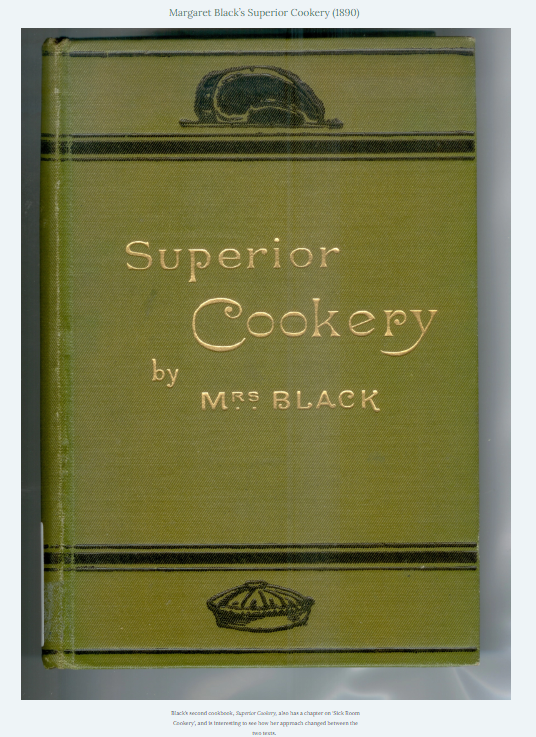
In 1878, Black left the Glasgow School of Cookery to set up her own institution, potentially after religious differences between her and the School’s principal, Grace Paterson (Thompson and McCallum 1998: 13). It was then that Black set up the West End School of Cookery, and during this time she published cookbooks including Household Cookery and Laundry Work (1882) and Superior Cookery (1890). These cookbooks demonstrate the blending of health and cookery that was typical throughout the nineteenth and into the twentieth century.
‘improper or unsuitable food generally impairs health or saps its foundations; and want of health impairs very greatly the energy and usefulness, as well as the individual happiness’
Black emphasises the links between food, cooking and health from the outset of Household Cookery and Laundry Work. Noting the importance of women having adequate and thorough training in cookery, Black writes in her introduction that ‘perhaps the most important result of this training is, that a knowledge of the constituents of different classes of food is acquired, and children may be fed with suitable food, which so greatly promotes health’ (1882: 8-9). In Black’s opinion, women must not only be educated on the efficient running of the home or in preparing tasty food, but on health, as ‘improper or unsuitable food generally impairs health or saps its foundations; and want of health impairs very greatly the energy and usefulness, as well as the individual happiness’ (1882: 9). Food and health, for Black, could not be separated.
The rest of the cookbook’s introduction contains a discussion of the ‘different constituents’ of food which must be eaten to ensure good health: ‘Nitrogenous, Carbonaceous, and Mineral Foods’. As Black explains, ‘Nitrogenous food forms flesh and muscle and supplies strength; carbonaceous food gives heat and acts as the fuel to the engine; mineral food is necessary for the formation and repair of bone, and is an important constituent of the blood’. The introduction of Black’s cookbook shows her interest in the scientific nature of food, and she provides lists which tell readers which foods fit each category. Black did not come up with this theory herself, however. The three constituents of diet were taken from the work of the influential German chemist, Justus von Liebig (1803-1873).
Liebig specialised in organic chemistry, and his publications focused on plants and animals, and later on food and nutrition. Influenced by his work on the mineral nutrition of plants and soil fertility, in which Liebig identified the chemical elements needed for plant growth, Liebig determined that nitrogenous foods helped the human body to build tissue, while ‘nonnitrogenous aliments maintained respiration and body heat’ (Finlay 1992: 406). Black’s adoption of Liebig’s theory in her cookbook shows her engagement with popular discourses surrounding health, nutrition and food. Indeed, Black mentions Liebig later in the cookbook in her discussion of tea: ‘It also contains a peculiar substance called theine, which Liebig says “plays a part in the nourishment of the body”’ (1882: 119). She was clearly well-versed in the discussions about food and science that circulated throughout the nineteenth century.
‘Sick nursing is even more essentially women’s work than housekeeping, and requires knowledge, combined with tenderness and care, a feeling heart, and skilful hands’
In her chapter on Sick-Room cookery, Black writes that ‘Sick nursing is even more essentially women’s work than housekeeping, and requires knowledge, combined with tenderness and care, a feeling heart, and skilful hands’ (1882: 107). This statement reveals just how important Black thought invalid cookery was. By describing sick-nursing as a skill that requires ‘tenderness and care, a feeling heart, and skilful hands’ Black characterises the treatment of the ill as a feminine task. This is perhaps not surprising, given Black’s role as an educator of women. But rather than subscribing to the common idea that efficient housekeeping and the well-ordered home was the most important thing for a woman to master, Black saw the care of the sick as the most ‘essential’ of women’s work. For Black, knowing how to prepare food for the ill was clearly a core skill that all women should have.

These principles ran through Black’s other publications and her teachings, and the links between food and health are traceable in the archival student notes and resources from Glasgow’s historical cooking schools. Jumping forward in time, and they still proliferated at the GWSCDS. In 1926, the college formally tied domestic science education to health when it launched the Sister Tutor’s and Dietetics course. One of the women behind the course was Mary Andross, a graduate of the University of Glasgow who joined the college in 1925. Having previously worked at the Ministry of Munitions Inspectorate on Poison Gasses, Mary turned her skills towards analysing the effect of cooking on the nutrients in everyday foodstuffs, which contributed to the scientific approach to food and health within the GWSCDS (Thompson and McCallum 1998: 49).
When the Sister Tutor’s and Dietetics course launched, it was the first of its kind not just in Scotland, but outside of London. It had health and the treatment of the sick at its core, and was open to two different types of women. Those were students who had achieved a Group 1 Diploma in another course (cookery, needlework or housewifery), or trained nurses who already worked in hospitals. These nurses could then go on to teach in training schools. All students who took the course became qualified dietitians, who could work in hospitals or other institutions, either as a ‘Sister Tutor’ or a ‘Dietitian’. These were distinct qualifications, but the syllabus was the same for both branches. The syllabi shows that the course covered subjects including bacteriology, physiology, cookery, hygiene and laundrywork – all topics women needed to know if they were going to care for invalids.
While issues with the General Nursing Council for Scotland meant the course dropped the Sister Tutors portion in the 1940s, the dietetics course remained. The GWSCDS retained its focus on the links between food, nutrition and health, and the dietetics courses that still run at Glasgow Caledonian University are the longest running in the UK.
Even for those women who did not undertake an education in dietetics, publications including the Glasgow Cookery Book, first published as a learning aid by the college in 1910, meant that the principles of health and nutrition could be learned and practiced within the home. Indeed, the Glasgow Cookery Book contained a chapter on ‘Invalid Recipes’ right up until the Centenary Edition was published in 1975. These recipes were based on the syllabi designed, taught, and learned by women. Their reprinting over the course of seventy years demonstrates how important the connections between food and health were to the women who facilitated and disseminated culinary education in Glasgow.
This blog is based on research undertaken by Lindsay Middleton as part of her Dishes for the Sick Room project, which can be explored via the website here.
Text Copyright © 2023 Lindsay Middleton
LinkedIn: Lindsay Middleton
Twitter: @lindsmiddleton
Cite this page as: Lindsay Middleton, “Cookery and Health in Glasgow’s Culinary History,” Women’s History Scotland blog (15 October 2023), http://womenshistoryscotland.org/?p=2857, accessed [today’s date]
References
Black, Margaret. 1882. Household Cookery and Laundrywork (London and Glasgow: William Collins, Sons, & Co).
Finlay, Mark R. 1992. ‘Quackery and Cookery: Just Von Liebeg’s Extract of Meat and the Theory of Nutrition in the Victorian Age’, Bulletin of the History of Medicine 66.3, 404–18.
Thompson, Willie and Carole McCallum. 1998. Glasgow Caledonian University: Its Origins and Evolution (Glasgow: Tuckwell Press).
To contribute to our blog, please get in touch!