
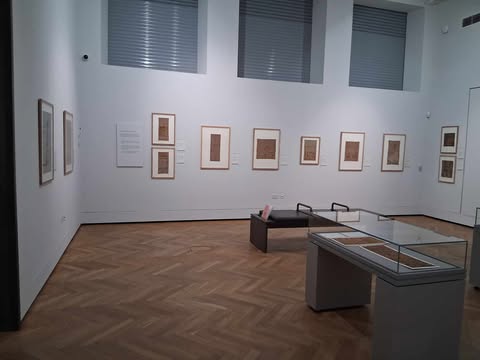
In our latest instalment of ‘Our Gallivanting’, WHS Steering Committee member Alison McCall explores Aberdeen Art Gallery’s exhibition of embroidered samplers, on display until November 2025. Reading Between Lines: Embroidered Samplers provides insights into the lives of the girls who sewed the samplers and the social, political and religious environment in which they lived in the 1700s and 1800s. Each sampler is a personal narrative, preserving family and social history through embroidery.
Aberdeen Art Gallery has a small exhibition of samplers on display in Gallery 3 until November 2025. The majority are from Aberdeen and Aberdeenshire.
I particularly liked the pair of samplers, worked approximately 30 years apart, but including similar motifs, by Isabel Forbes (b approx. 1783 – 1853) and her daughter Mary Kellas (1821- 1891). Both samplers contain the initials of family members. Mary’s sampler is dated 1835, and it is easy to imagine her mother passing on family stories as she stitched.


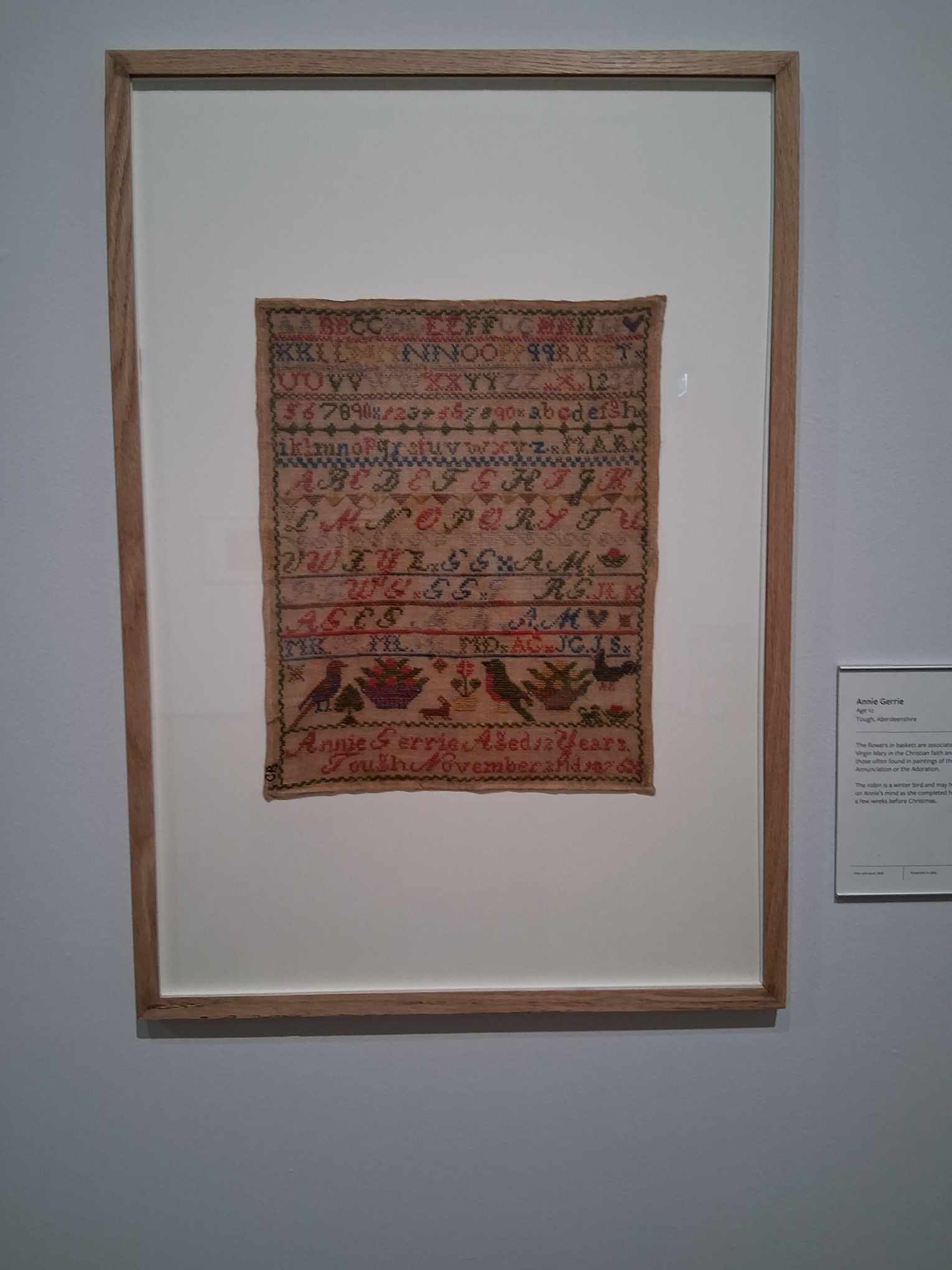
As I am interested in schoolteachers, I was keen to learn more about the sampler by Annie Gerrie from Tough, who was 12 when she completed her sampler in 1876. She was the daughter of George Gerrie, a farm overseer, and his wife Annie McKay. The sampler comprises eight rows of alphabets in different fonts and colours, followed by her parents’ initials, GG and AM. This is followed by the initials of her six siblings and Annie herself. There are several other sets of initials, presumably those of other more distant family members – M.A.R, A.C, J.S. The School Admission records for Tough School show that Annie Gerrie was almost 9 when she started school on 1 April 1874. Her younger sister Elizabeth started on the same day. Once at school, Annie progressed smoothly through the standards, remaining in school until 1881. Thereafter she became a teacher in Aberdeen. She died, aged just 25, in 1891, following an operation to remove an ovarian cyst. Looking at the sampler I see a treasured item, carefully preserved by her family after her death.
Another interesting example in the exhibition takes the form of a long roll of material demonstrating various sewing stitches and techniques, of which the sampler, worked in red, forms only one section. It was the work of Mary Helen MacMahon, born around 1870 in England, the daughter of photographer John MacMahon, who had a successful business in Aberdeen. Unlike Mary Kellas or Annie Gerrie, who grew up in rural Aberdeenshire, Mary Helen MacMahon grew up in the affluent West End of Aberdeen. In 1885, she was being educated in the Ursuline Convent in Tildonck, Belgium, and it was there that she worked this impressive piece of needlework. After completing her education, she returned home to Aberdeen. She married solicitor George MacKenzir in 1903 and had three daughters. Mary Helen died in Aberdeen in 1957.

Each of the samplers in this exhibition tells us something of the woman who created it. I intend to keep revisiting it until November.
Text Copyright © 2025 Alison McCall
Cite this page as: Alison McCall, ‘Reading Between Lines – Embroidered Samplers’, Women’s History Scotland blog (01 February 2025), https://womenshistoryscotland.org/?p=3366, accessed [today’s date]
To contribute to our ‘Out Gallivanting’ blog, please get in touch!
It’s a lovely exhibition and good to see that it includes many remarkable samplers from Aberdeen and the Nirth East. Some of the girls who completed these were only nine years old. The girls needlework skills are so impressive. Definitely worth a visit to Aberdeen city centre and the Art Gallery in Schoolhill to see them.